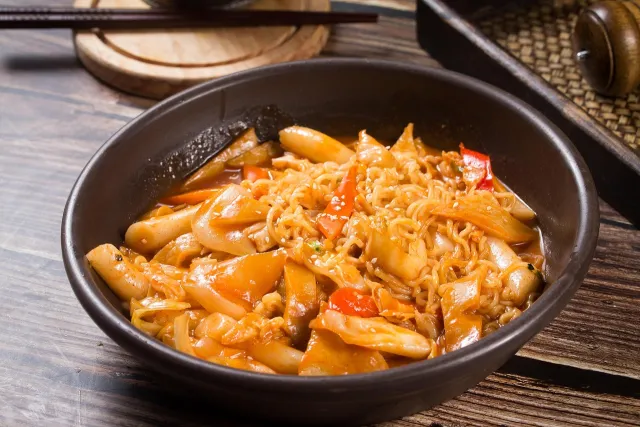
Korean Table Manners: From Chopstick Etiquette to Drinking Customs, Barbecue Restaurants and Paying the Bill
What should you know before eating in Korea? We explain how to use spoon and chopsticks, eating with elders, side-dish culture, pouring and receiving drinks, barbecue restaurants and how paying works — from a foreigner's point of view.

Contents
- The basic layout of a Korean meal
- Using spoon and chopsticks
- Eating with elders
- Side-dish culture: free refills and sharing
- Eating soups and stews
- At a Korean barbecue restaurant
- Useful restaurant customs
- Drinking etiquette
- Paying the bill: splitting it and "I'll get this"
- When you're invited to a Korean home
- Useful phrases
- Common mistakes foreigners make
- Korean restaurants today: kiosks, tablets and call buttons
- Hoesik: the office dinner
- Dining etiquette on special occasions
- Small courtesies when eating with Korean friends
- Korea has no tipping culture
- Floor-seating restaurants and taking off shoes
- The rise of honbap (eating alone)
- Taking leftovers home and delivery culture
- Frequently asked questions
- Final thought: what eating together means
Foreigners visiting a Korean restaurant for the first time often get flustered at the same moments. Side dishes they didn't order cover the table; the spoon and chopsticks are made of metal; there's a button on the table to call the staff. At barbecue restaurants customers grill the meat themselves, and when an elder pours you a drink, you accept the glass with both hands and turn your head away to drink.
Korean table manners grew out of a culture of eating together and respecting elders. They may look like strict rules, but once you understand the principles they're easy to follow. And Koreans don't expect foreigners to observe every rule perfectly. Know and practise just a few and you'll be complimented: "You really know Korean culture!" In this guide we've organised the etiquette worth knowing when eating in Korea, situation by situation.
The basic layout of a Korean meal
A traditional Korean meal consists of rice, soup and various side dishes. Rice goes on the left, soup on the right, and side dishes in the middle for everyone to share. The spoon and chopsticks are placed vertically on the right.
Where a Western meal is a "course" with dishes served one at a time to each person, a Korean meal is laid out all at once across the table. That's why Koreans speak of "setting the table" (sangeul charinda), and the natural way to eat is to sample many side dishes a little at a time with your rice.
Using spoon and chopsticks
Dividing the work
In Korea, spoon and chopsticks are used together. Generally, rice and soup are eaten with the spoon and side dishes with chopsticks. Unlike in Japan or China, lifting your rice bowl and eating rice with chopsticks is uncommon in Korea; the usual etiquette is to leave the bowl on the table and eat rice with the spoon.
Metal chopsticks
Korean chopsticks are mostly made of metal such as stainless steel. They're flat and thin and can feel tricky at first. If slippery side dishes are hard to pick up, it's fine to use your spoon as well. Koreans are forgiving of clumsy chopstick skills.
Taboos
- Don't stick utensils upright in rice: it evokes an ancestral memorial table and should be avoided.
- Don't hold spoon and chopsticks in one hand together: etiquette is to use one at a time.
- Don't rummage through side dishes: poking around a shared dish to pick out what you want is considered rude.
- Don't tap bowls with your utensils: making noise can look impolite.
Eating with elders
The heart of Korean table manners is respect for elders. When eating with family, a boss or older people, remember the following.
- Let elders start: wait for the eldest person to pick up their utensils before you begin.
- Match the pace: rather than eating fast and leaving first, keep pace with your elders.
- Seating: the seat furthest from the door is usually the seat of honour, for the most senior person.
- Mealtime phrases: say jal meokgetseumnida ("I'll eat well") before the meal and jal meogeotseumnida ("I ate well") after — important words of thanks to whoever is treating you.
These customs have become much more relaxed among younger generations, but they still matter, especially with elders you've just met or at formal occasions.
Side-dish culture: free refills and sharing
One of the most distinctive features of Korean restaurants is the array of side dishes (banchan) served with the main dish: kimchi, seasoned vegetables, stir-fried fish cake, seasoned bean sprouts and more, varying by restaurant. Most are refilled for free.
- Asking for more: when a side dish runs out, ask "banchan deo juseyo" (more side dishes, please) or "igeo jogeum deo juseyo" (a little more of this, please). Some restaurants have a self-service side-dish station.
- Take portions from shared dishes: side dishes in the middle are for everyone, so take only a bite's worth at a time with your chopsticks or put some on your small plate.
- Don't waste food: take only what you'll eat. Many restaurants now post signs asking diners to take only what they need, to reduce food waste.
Eating soups and stews
Korean meals often come with soup or stew. If you have your own soup bowl, eat it with your spoon; if a single stew is shared, ladle some into your own bowl. Everyone dipping their spoons into one pot used to be common, but serving into individual bowls is increasingly the norm for hygiene.
It's more usual to eat broth with a spoon than to drink from the bowl. Cold noodle soups such as naengmyeon are an exception, where people often lift the bowl to drink the broth.
At a Korean barbecue restaurant
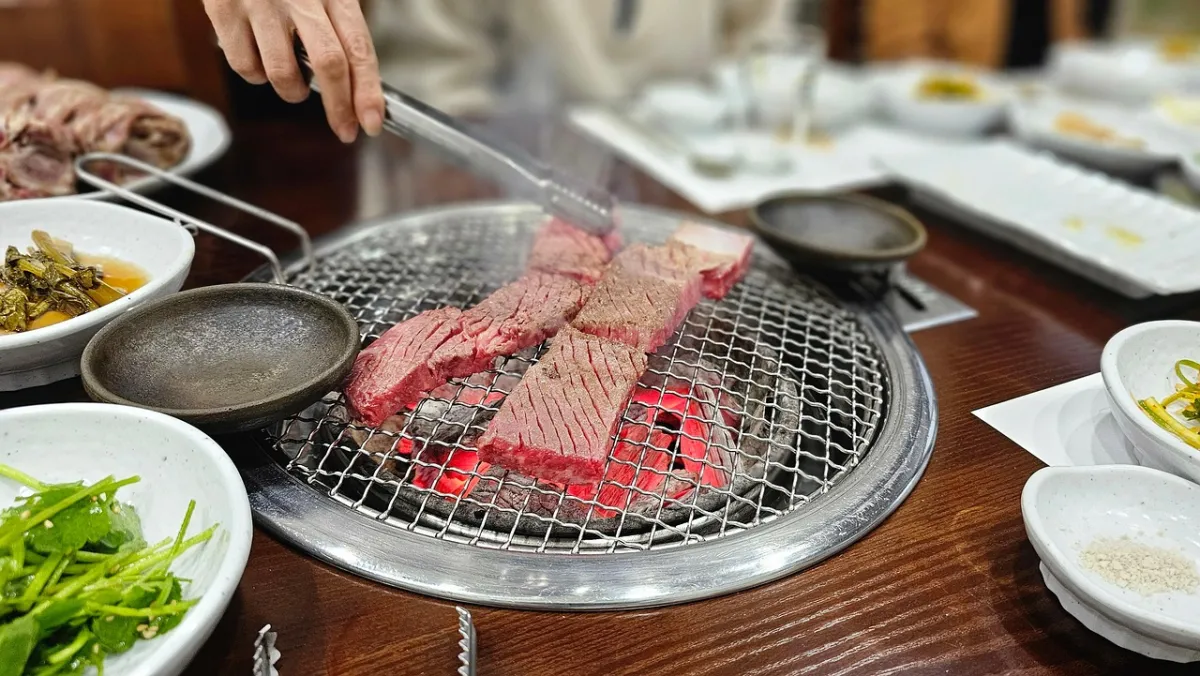
No trip to Korea is complete without a barbecue restaurant. Grilling pork belly, galbi or bulgogi yourself on a grill built into the table is especially popular with foreigners.
Grilling the meat
At many barbecue restaurants customers grill the meat themselves, though at some the staff do it. In a group, usually the youngest person or the most skilled griller takes the tongs and scissors. Cutting the cooked meat into bite-sized pieces with scissors is one of the sights foreigners find most surprising.
Making lettuce wraps
The Korean way is to place grilled meat on lettuce or perilla leaves, top it with ssamjang (dipping paste), garlic, chilli and seasoned green onion, and wrap it into one bite. Keep wraps small enough to eat in one mouthful. Handing someone a carefully made wrap is a gesture of affection and friendliness.
Finishing the meal
After the meat, it's common to order doenjang jjigae and rice, or cold noodles, to finish. Some places offer fried rice made by stir-frying the leftover meat and kimchi with rice on the grill.
Useful restaurant customs
- Call buttons: many tables have a button to call staff. Press it and someone will come. Without one, raise your hand and say "jeogiyo!" or "yeogiyo!"
- Water and utensils are often self-service: at many restaurants you fetch water, cups and utensils yourself; utensils are often in a drawer at the side of the table.
- Two-portion minimums: some barbecue and stew restaurants only accept orders for two portions or more. If you're alone, look for places with single-portion menus.
- Kiosk ordering: fast-food chains, cafés and some restaurants use self-order kiosks, often with English menus.
- No tipping: tipping isn't customary in Korea; think of service as included in the price.
Drinking etiquette
Korean drinking sessions come with their own etiquette, especially important at company dinners or when drinking with elders.
Pouring and receiving
- Don't pour your own: in Korea it's customary to pour for each other rather than fill your own glass. If someone's glass is empty, top it up.
- Use two hands: when pouring for an elder, hold the bottle in your right hand and support your right wrist or elbow with your left. When receiving, hold your glass with both hands.
- Turn your head to drink: when drinking in front of an elder, turn your head slightly to the side and cover your mouth with your hand.
- The first glass: the first glass is often drunk together after a toast.
Toasting
Koreans toast with "geonbae!" (cheers) or "wihayeo!" ("to us!"). When clinking glasses with an elder, hold your glass slightly lower than theirs as a sign of respect.
Towards a culture without pressure
There used to be a culture of pressuring people to drink, but respect for personal choice has spread widely. If you don't drink, politely say "jeoneun sureul an masyeoyo" (I don't drink) and join toasts with a soft drink or water.
Paying the bill: splitting it and "I'll get this"
How the bill is paid depends on the situation.
- The elder or host pays: traditionally, the oldest person, the boss or whoever suggested the meal often paid. You'll sometimes see people tussling at the counter, each insisting on paying.
- Splitting the bill: among friends and colleagues, paying for what you ate or splitting evenly is common, often settled quickly with transfer apps.
- "Next time it's on me": if someone treats you, the custom is to return the favour next time with coffee or a meal.
- Pay at the counter: most Korean restaurants have you pay at the counter by the entrance after the meal; paying at the table is less common.
When you're invited to a Korean home
If you're invited to a Korean home, bring a small gift — fruit, drinks or dessert are safe choices. Take off your shoes at the entrance, and after the meal thank your hosts: "jal meogeotseumnida, jeongmal masisseosseoyo" (thank you for the meal, it was delicious). Korean elders often keep offering food to guests; if you're full, it's fine to decline politely: "jeongmal mani meogeosseoyo, gamsahamnida" (I've really eaten a lot, thank you).
Useful phrases
| Situation | Phrase |
|---|---|
| Before eating | Jal meokgetseumnida |
| After eating | Jal meogeotseumnida |
| Praising the food | Jeongmal masisseoyo (it's really delicious) |
| Toasting | Geonbae! / Wihayeo! |
| Offering food | Mani deuseyo (please eat a lot) |
| When you're full | Baebulleoyo, chungbunhi meogeosseoyo (I'm full, I've had plenty) |
| After being treated | Daeumen jega salgeyo (next time it's on me) |
Common mistakes foreigners make
- Lifting the rice bowl: in Korea it's usual to leave the bowl on the table and eat with a spoon.
- Pouring your own drink: not rude as such, but the Korean way is to wait for a companion to pour.
- Blowing your nose: doing so at the table during a meal is considered rude; excuse yourself briefly instead.
- Taking too many shared side dishes and leaving them: take only what you'll eat.
There's no need to be nervous, though. If a foreigner makes a mistake, most Koreans will smile and gently explain, and they appreciate the effort to learn.
Korean restaurants today: kiosks, tablets and call buttons
Ordering methods in Korean restaurants are changing fast. Know these few things so you're not caught off guard on your first visit.
- Kiosks: at fast-food outlets, cafés and bunsik shops, you choose and pay at a self-order machine by the entrance. Many let you switch the language on screen. Take the receipt with your order number and collect your food when the number appears on the display or is called.
- Table tablets: more and more restaurants let you order from a tablet on your table, which also handles extra orders and calling staff.
- Call buttons: many restaurant tables have a small button. Press it when you need staff — very handy when you'd rather not shout across the room.
- Pay first or pay later: bunsik shops and some eateries take payment when you order, while regular restaurants have you pay at the counter after eating. Paying at the table is rare.
Hoesik: the office dinner
Hoesik, a meal shared by colleagues, has long played an important role in Korean work culture, and it appears often in office scenes in dramas.
- Seating: the boss usually takes the seat of honour further inside, while the most junior employee often sits near the door, handling orders and errands.
- Setting the cutlery: at a BBQ restaurant, you'll often see the youngest lay out napkins, place spoons and chopsticks on them for everyone and pour the water.
- Toasts: at a hoesik, the boss or head of the team calls out a short toast and everyone raises their glass together.
- A changing culture: these days, a culture of not pressuring people to drink has taken hold, and alternatives such as lunch gatherings or outings to films and performances are increasingly common. If you don't drink, toasting with a soft drink is absolutely fine.
Dining etiquette on special occasions
Doljanchi (first-birthday party)
If you're invited to a doljanchi celebrating a child's first birthday, bring congratulations along with a gift or cash in an envelope. The highlight is doljabi, where the child picks one of several objects — thread, a pencil, money and so on — and guests playfully predict the child's future from the choice.
Wedding receptions
After a Korean wedding ceremony, guests share a meal. Buffets are common, and traditionally guests were served janchi-guksu (banquet noodles). That's why Koreans sometimes ask, jokingly, "When are you going to feed us noodles?" to mean "When are you getting married?"
Funeral halls
At funeral halls, mourners are served food such as yukgaejang (spicy beef soup), rice cakes and sliced boiled pork. After paying respects, it's courteous to eat in the area provided — but don't laugh loudly or make toasts.
Small courtesies when eating with Korean friends
- If water is self-service, pour some for your companions too. It's a small gesture, but it shows thoughtfulness.
- For shared dishes such as stews and hotpots, serve yourself onto a personal plate; many restaurants provide a shared ladle.
- Near the end of a meal there may be a subtle battle over who pays. Among friends, splitting the bill or taking turns — one pays this time, the other next time — is common.
- Saying "잘 먹었습니다" ("I ate well") after the meal thanks whoever treated you.
Korea has no tipping culture
Tipping is not customary in Korean restaurants. VAT is already included in the menu prices, so you simply pay the amount shown. Some high-end hotel restaurants add a service charge, but even then it's shown on the bill in advance. If you enjoyed the service, the most Korean way to say thanks is not a tip but a parting "잘 먹었습니다" (I ate well) or "맛있었어요" (It was delicious). Owners and staff take real pride in that short phrase, and once you become a regular you may experience the warm affection known as jeong — extra side dishes, or a drink on the house.
Floor-seating restaurants and taking off shoes
Many restaurants in Korea still have floor seating, where you sit on cushions on the floor. In these places you must take off your shoes before stepping up into the room, and there's usually a shoe rack or a space to line them up at the entrance. Checking beforehand that your socks have no holes is a small but useful tip. Men often sit cross-legged and women with their knees folded to one side, but these days any comfortable position is fine, and shifting position when your legs go numb isn't rude. More restaurants are also replacing floor seating with tables for foreign and older customers.
The rise of honbap (eating alone)
Going to a restaurant alone used to feel awkward in Korea. Many restaurants only accepted orders for two or more, and sitting alone could make you self-conscious. But as single-person households have grown dramatically, honbap — "eating alone" — has become a natural part of life. There are now more restaurants with partitioned solo seats, barbecue places selling single portions of meat, and gukbap and snack shops where eating alone is perfectly comfortable. Some barbecue, jjim and jeongol places still require orders for two, though, so if you're travelling solo, ask whether a single portion is possible before ordering. "1인분도 돼요?" (Can I order one portion?) is all you need.
Taking leftovers home and delivery culture
If you can't finish your food in a Korean restaurant, you can ask to take it away. Say "포장해 주세요" (Please wrap it up) and most places will pack it in a container. At all-you-can-eat restaurants and buffets, however, you can't take leftovers, and some charge extra if you leave a lot of food. Korea also has a highly developed delivery culture: order through an app and food such as fried chicken, jajangmyeon or jokbal can be delivered even to a park or the banks of the Han River. After eating delivery food, it's basic etiquette to clean the containers and sort them for recycling.
Frequently asked questions
Is it rude if I'm bad with chopsticks?
Not at all. Korean metal chopsticks are tricky even for Koreans at first. Feel free to ask for a spoon or fork if you need one.
Is it OK to eat alone at a restaurant?
Absolutely. Honbap — eating alone — has become widespread, and many restaurants now offer single seats and single-portion menus.
Is it rude to leave food?
Leaving a little because you're full is fine. But taking lots of side dishes and leaving them is frowned upon because of food waste, so take only what you need.
Final thought: what eating together means
The Korean word for family, sikgu, literally means "mouths that eat together". Korean table manners ultimately come from care and respect for the people you share a meal with. Sharing side dishes, filling an elder's glass and saying "jal meokgetseumnida" — small gestures like these make a table warm.
Next time you eat at a Korean restaurant, try practising just one of these customs. The smile it brings to your Korean companion's face will be the warmest reply of all.