80 Essential Korean Phrases for Travel: From the Airport to Restaurants, Shopping, Transport and Emergencies
You can travel Korea without speaking Korean, but a few words make the trip far more enjoyable. Here are practical phrases with pronunciation for the airport, accommodation, restaurants, cafés, shopping, transport and emergencies.

Contents
- Ground rules for travel Korean
- Greetings and basics
- At the airport
- At your accommodation
- At restaurants: from ordering to paying
- At a café
- Shopping
- Transport: subway, bus and taxi
- Asking for directions
- Reading numbers and prices
- In an emergency
- Etiquette when speaking Korean
- Combining phrases with a translation app
- Understanding what staff will ask you
- At markets and street-food stalls
- Korean for the pharmacy
- Words that soften a conversation
- Small talk with locals
- Booking a restaurant by phone
- How to read Korean addresses
- Asking for help
- Body-language etiquette that matters as much as words
- Asking someone to take a photo
- Saying no politely
- Frequently asked questions
- Final thought: the power of one word
Korea is an easy country for foreigners to travel. Subway announcements are made in English too, major sights have good foreign-language signage, and translation apps work well. You can travel perfectly well without a word of Korean.
Yet people who've been there say the same thing: "Trying even a few words made it so much better." Stories of a restaurant owner beaming and bringing extra side dishes after hearing "masisseoyo!" ("it's delicious!"), or a market trader striking up a conversation after being asked "eolmayeyo?" ("how much?"), are common. In this guide we've gathered the phrases you'll really use when travelling in Korea, sorted by situation, with Hangul and a romanised pronunciation. Every phrase uses the polite haeyo style, so none of them will be rude to strangers.
Ground rules for travel Korean
- End with -yo: sentences ending in -yo are polite. With people you've just met, it's always safe to add it.
- Juseyo is your all-purpose word: add juseyo ("please give me") after what you want and you've made most requests — mul juseyo (water, please), igeo juseyo (this one, please).
- It doesn't have to be perfect: Koreans will usually understand slightly wrong pronunciation, and they appreciate foreigners making the effort.
- Use gestures: point to the photo on a menu and say igeo juseyo, and almost any order is sorted.
Greetings and basics
| Meaning | Korean | Pronunciation |
|---|---|---|
| Hello | 안녕하세요 | annyeonghaseyo |
| Thank you | 감사합니다 / 고맙습니다 | gamsahamnida / gomapseumnida |
| I'm sorry | 죄송합니다 | joesonghamnida |
| Excuse me | 실례합니다 | sillyehamnida |
| Yes / No | 네 / 아니요 | ne / aniyo |
| It's OK / No thanks | 괜찮아요 | gwaenchanayo |
| Just a moment | 잠깐만요 | jamkkanmanyo |
| I don't know | 잘 모르겠어요 | jal moreugesseoyo |
| I don't speak Korean well | 한국어 잘 못해요 | hangugeo jal motaeyo |
| Do you speak English? | 영어 할 수 있어요? | yeongeo hal su isseoyo? |
| Please speak slowly | 천천히 말해 주세요 | cheoncheonhi malhae juseyo |
| Goodbye (when you're leaving) | 안녕히 계세요 | annyeonghi gyeseyo |
| Goodbye (when they're leaving) | 안녕히 가세요 | annyeonghi gaseyo |
Gwaenchanayo is incredibly useful. You can answer "are you OK?" with it, and you can use it to decline something politely. When a cashier asks if you need a bag, gwaenchanayo means "no, I'm fine".
At the airport
| Situation | Korean | Pronunciation |
|---|---|---|
| Where is the toilet? | 화장실이 어디예요? | hwajangsiri eodiyeyo? |
| Where do I take the airport railroad? | 공항철도는 어디서 타요? | gonghangcheoldoneun eodiseo tayo? |
| A transport card, please | 교통카드 주세요 | gyotongkadeu juseyo |
| Please top it up | 충전해 주세요 | chungjeonhae juseyo |
| Do you have SIM cards? | 유심 카드 있어요? | yusim kadeu isseoyo? |
| I'd like to exchange money | 환전하고 싶어요 | hwanjeonhago sipeoyo |
At your accommodation
| Situation | Korean | Pronunciation |
|---|---|---|
| I'd like to check in | 체크인하고 싶어요 | chekeuinhago sipeoyo |
| I have a reservation | 예약했어요 | yeyakaesseoyo |
| What's the Wi-Fi password? | 와이파이 비밀번호가 뭐예요? | waipai bimilbeonhoga mwoyeyo? |
| Can I leave my luggage? | 짐 좀 맡길 수 있어요? | jim jom matgil su isseoyo? |
| What time is check-out? | 체크아웃은 몇 시예요? | chekeuauseun myeot siyeyo? |
| There's a problem with my room | 방에 문제가 있어요 | bange munjega isseoyo |
Loanwords such as hotel, Wi-Fi and check-in are English words adapted to Korean pronunciation, so they're easy to understand. Saying an English word slowly with a Korean accent often works.
At restaurants: from ordering to paying
Getting a table
| Situation | Korean | Pronunciation |
|---|---|---|
| (Staff) How many people? | 몇 분이세요? | myeot buniseyo? |
| Two people | 두 명이에요 | du myeongieyo |
| Just me | 혼자예요 | honjayeyo |
| A menu, please | 메뉴판 주세요 | menyupan juseyo |
| Do you have an English menu? | 영어 메뉴 있어요? | yeongeo menyu isseoyo? |
Ordering
| Situation | Korean | Pronunciation |
|---|---|---|
| Excuse me! (calling staff) | 저기요! | jeogiyo! |
| This one, please | 이거 주세요 | igeo juseyo |
| Two of these, please | 이거 두 개 주세요 | igeo du gae juseyo |
| What's good here? | 뭐가 맛있어요? | mwoga masisseoyo? |
| Is this spicy? | 이거 매워요? | igeo maewoyo? |
| Not spicy, please | 안 맵게 해 주세요 | an maepge hae juseyo |
| Without meat, please | 고기 빼 주세요 | gogi ppae juseyo |
| I'm vegetarian | 저는 채식주의자예요 | jeoneun chaesikjuuijayeyo |
| I'm allergic to peanuts | 땅콩 알레르기가 있어요 | ttangkong allereugiga isseoyo |
During the meal
| Situation | Korean | Pronunciation |
|---|---|---|
| Some water, please | 물 좀 주세요 | mul jom juseyo |
| More side dishes, please | 반찬 더 주세요 | banchan deo juseyo |
| A small plate, please | 앞접시 주세요 | apjeopsi juseyo |
| It's delicious! | 맛있어요! | masisseoyo! |
| I'll enjoy this meal (before eating) | 잘 먹겠습니다 | jal meokgetseumnida |
| Thank you for the meal (after eating) | 잘 먹었습니다 | jal meogeotseumnida |
Paying
| Situation | Korean | Pronunciation |
|---|---|---|
| The bill, please | 계산해 주세요 | gyesanhae juseyo |
| Can I pay by card? | 카드 돼요? | kadeu dwaeyo? |
| We'll pay separately | 따로 계산할게요 | ttaro gyesanhalgeyo |
| To take away, please | 포장해 주세요 | pojanghae juseyo |
| A receipt, please | 영수증 주세요 | yeongsujeung juseyo |
Korean restaurants often refill side dishes for free, so remember banchan deo juseyo. Some have a self-service side dish station instead. There's no tipping.
At a café
| Situation | Korean | Pronunciation |
|---|---|---|
| One iced americano, please | 아이스 아메리카노 한 잔 주세요 | aiseu amerikano han jan juseyo |
| A hot one, please | 따뜻한 거로 주세요 | ttatteutan georo juseyo |
| For here | 여기서 먹을게요 | yeogiseo meogeulgeyo |
| To go | 가지고 갈게요 | gajigo galgeyo |
| A large size, please | 사이즈 크게 해 주세요 | saijeu keuge hae juseyo |
| Less sweet, please | 덜 달게 해 주세요 | deol dalge hae juseyo |
Koreans love iced americanos even in the depths of winter — so much so that there's a slang term, eoljuga, short for "iced americano even if I freeze to death". You'll also hear people order an a-a, short for "ice americano".
Shopping
| Situation | Korean | Pronunciation |
|---|---|---|
| How much is it? | 얼마예요? | eolmayeyo? |
| Do you have this? | 이거 있어요? | igeo isseoyo? |
| Can I try it on? | 입어 봐도 돼요? | ibeo bwado dwaeyo? |
| Do you have another colour? | 다른 색 있어요? | dareun saek isseoyo? |
| Do you have a bigger size? | 더 큰 사이즈 있어요? | deo keun saijeu isseoyo? |
| Could you give me a discount? (markets) | 좀 깎아 주세요 | jom kkakka juseyo |
| I'm just looking | 그냥 구경하는 거예요 | geunyang gugyeonghaneun geoyeyo |
| Can I get a tax refund? | 택스 리펀드 돼요? | taekseu ripeondeu dwaeyo? |
| I don't need a bag | 봉투 필요 없어요 | bongtu piryo eopseoyo |
Don't bargain at fixed-price shops such as department stores and cosmetics chains. At small stalls in traditional markets you can gently try jom kkakka juseyo when buying several items, but aggressive haggling can be rude. You may instead experience deom — the generous custom of throwing in a little extra.
Transport: subway, bus and taxi
| Situation | Korean | Pronunciation |
|---|---|---|
| Where is ○○ station? | ○○역이 어디예요? | ○○ yeogi eodiyeyo? |
| Does this bus go to ○○? | 이 버스 ○○ 가요? | i beoseu ○○ gayo? |
| Where do I transfer? | 어디서 갈아타요? | eodiseo garatayo? |
| (Taxi) To ○○, please | ○○으로 가 주세요 | ○○euro ga juseyo |
| Please stop here | 여기서 세워 주세요 | yeogiseo sewo juseyo |
| How long does it take? | 얼마나 걸려요? | eolmana geollyeoyo? |
| Could you open the boot/trunk? | 트렁크 좀 열어 주세요 | teureongkeu jom yeoreo juseyo |
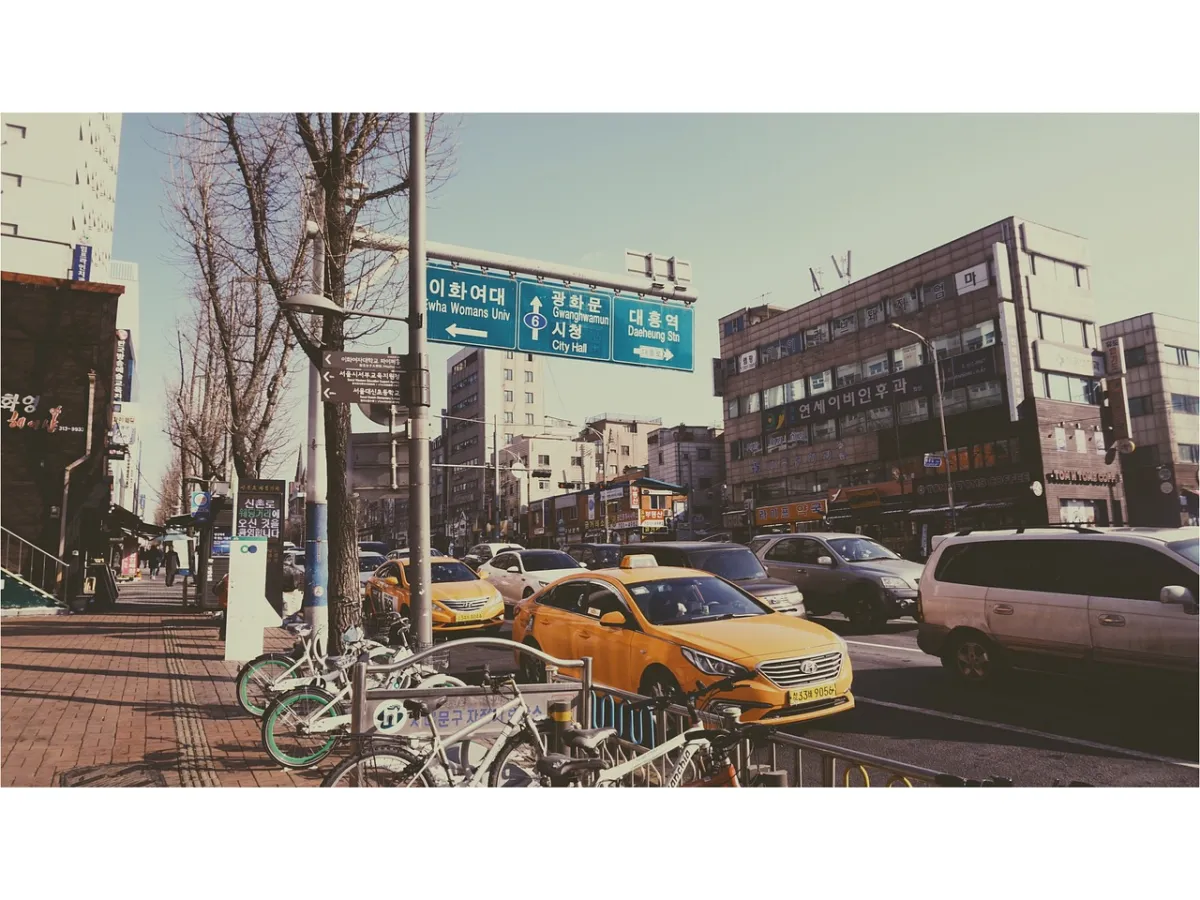
In a taxi, showing your destination's address in Hangul is the most reliable approach. Save your accommodation's address in Hangul on your phone and you'll have a safety net if you get lost. Subway stations are named with yeok (station) on the end: Myeongdong-yeok, Hongik-daeipgu-yeok.
Asking for directions
| Meaning | Korean | Pronunciation |
|---|---|---|
| Where am I? | 여기가 어디예요? | yeogiga eodiyeyo? |
| Is it near? / far? | 가까워요? / 멀어요? | gakkawoyo? / meoreoyo? |
| Can I walk there? | 걸어서 갈 수 있어요? | georeoseo gal su isseoyo? |
| Right / left | 오른쪽 / 왼쪽 | oreunjjok / oenjjok |
| Go straight | 쭉 가세요 | jjuk gaseyo |
| Please show me on the map | 지도에서 보여 주세요 | jidoeseo boyeo juseyo |
Reading numbers and prices
Korean has two number systems. Sino-Korean numbers (il, i, sam…) are used for prices, phone numbers and dates; native Korean numbers (hana, dul, set…) for counting items, ages and the hour. When travelling, you'll use Sino-Korean numbers most, for prices.
| Number | Sino-Korean | Native Korean (counting) |
|---|---|---|
| 1 | 일 (il) | 하나 / 한 개 (hana / han gae) |
| 2 | 이 (i) | 둘 / 두 개 (dul / du gae) |
| 3 | 삼 (sam) | 셋 / 세 개 (set / se gae) |
| 4 | 사 (sa) | 넷 / 네 개 (net / ne gae) |
| 5 | 오 (o) | 다섯 (daseot) |
| 10 | 십 (sip) | 열 (yeol) |
| 100 / 1,000 / 10,000 | 백 / 천 / 만 (baek / cheon / man) | — |
Korea's currency is the won. Korean groups large numbers in units of ten thousand (man), so ₩15,000 is man ocheon won and ₩50,000 is oman won. It's confusing at first, but prices are usually displayed on the till screen, so it's rarely a problem.
In an emergency
| Situation | Korean | Pronunciation |
|---|---|---|
| Help! | 도와주세요! | dowajuseyo! |
| I'm sick / it hurts | 아파요 | apayo |
| Where is the hospital? | 병원이 어디예요? | byeongwoni eodiyeyo? |
| Where is a pharmacy? | 약국이 어디예요? | yakgugi eodiyeyo? |
| Please call the police | 경찰을 불러 주세요 | gyeongchareul bulleo juseyo |
| I lost my wallet | 지갑을 잃어버렸어요 | jigabeul ireobeoryeosseoyo |
| I'm lost | 길을 잃었어요 | gireul ireosseoyo |
Memorise the emergency numbers too: 112 for police and 119 for fire and ambulance. The 1330 tourist helpline offers interpretation and travel information in several languages, which is a huge help when communication is difficult. Lost items can often be recovered from subway lost-and-found centres or police stations.
Etiquette when speaking Korean
- A small bow: lowering your head slightly when greeting gives a polite impression.
- Giving and receiving with both hands: passing cards or items with two hands, or one hand supporting the other, looks courteous.
- Sajangnim and imo: calling a small shop's owner sajangnim ("boss") is friendly yet polite. Many Koreans affectionately call middle-aged women working in restaurants imo ("auntie").
- Keep your voice down: avoid loud conversations or phone calls on the subway and buses.
Combining phrases with a translation app
Translation apps are a reliable travel companion. Some can translate menus and signs in real time through your camera, so you can choose dishes even if you can't read Hangul. But apps don't always distinguish polite and casual speech correctly, and sometimes produce awkward sentences. The most effective approach is to say the short phrases in this guide yourself and show the app only for complicated matters.
Understanding what staff will ask you
A surprisingly important part of travel Korean isn't what you'll say but understanding what people ask you. Staff in each kind of place ask almost exactly the same questions, so learning them in advance means you can answer without panicking.
| Place | Staff question | Meaning and sample answer |
|---|---|---|
| Restaurant | 몇 분이세요? (myeot buniseyo?) | How many people? → "두 명이요." (Two.) |
| Fast food / café | 드시고 가세요? 포장이세요? (deusigo gaseyo? pojangiseyo?) | Eat in or take away? → "먹고 갈게요." (Eat in.) / "포장이요." (Take away.) |
| Café | 따뜻한 거로 드릴까요, 아이스로 드릴까요? | Hot or iced? → "아이스로 주세요." (Iced, please.) |
| Convenience store | 봉투 필요하세요? (bongtu piryohaseyo?) | Do you need a bag? → "아니요, 괜찮아요." (No, I'm fine.) |
| Convenience store | 데워 드릴까요? (dewo deurilkkayo?) | Shall I heat it up? → "네, 데워 주세요." (Yes, please.) |
| Checkout | 영수증 드릴까요? (yeongsujeung deurilkkayo?) | Would you like a receipt? → "네, 주세요." / "괜찮아요." |
| Checkout | 포인트 카드 있으세요? | Do you have a points card? → "없어요." (No.) |
| Taxi | 어디로 모실까요? (eodiro mosilkkayo?) | Where to? → Say your destination or show a map. |
| Accommodation | 성함이 어떻게 되세요? (seonghami eotteoke doeseyo?) | What's your name? → Give the name on the booking. |
괜찮아요 will be one of your most-used words. Besides "it's okay", it works as a polite refusal — "I don't need it", "no, thank you".
At markets and street-food stalls
Traditional markets and street food are among the great joys of travelling in Korea. A few words of Korean with market vendors make your trip much warmer.
- 이거 하나 주세요. (igeo hana juseyo) — One of these, please. Pointing as you say it is enough.
- 이거 뭐예요? (igeo mwoyeyo?) — What's this? For food you've never seen before.
- 매워요? (maewoyo?) — Is it spicy? An essential question if you're wary of heat.
- 맛있어요! (masisseoyo!) — It's delicious! Vendors love hearing this after you take a bite.
- 좀 깎아 주세요. (jom kkakka juseyo) — Could you knock a little off? Sometimes works at traditional markets, but don't use it in fixed-price shops.
- 카드 돼요? (kadeu dwaeyo?) — Can I pay by card? Some small market stalls take cash only.
Korean for the pharmacy
A mild cold or indigestion on your trip can often be handled at a pharmacy. Korean pharmacies are easy to spot by the 약 ("medicine") sign, and if you describe your symptoms the pharmacist will recommend suitable medicine.
| Korean | Meaning |
|---|---|
| 감기약 있어요? (gamgiyak isseoyo?) | Do you have cold medicine? |
| 머리가 아파요. (meoriga apayo) | I have a headache. |
| 배가 아파요. (baega apayo) | I have a stomach ache. |
| 소화제 주세요. (sohwaje juseyo) | Something for indigestion, please. |
| 열이 나요. (yeori nayo) | I have a fever. |
| 밴드 있어요? (baendeu isseoyo?) | Do you have plasters / band-aids? |
| 하루에 몇 번 먹어요? (harue myeot beon meogeoyo?) | How many times a day do I take it? |
Late at night it can be hard to find an open pharmacy. Convenience stores sell some basic medicines, so keep that in mind in a pinch. If symptoms are severe or persistent, see a doctor rather than a pharmacist.
Words that soften a conversation
Adding a few words before a short sentence makes your Korean much more polite and natural.
- 저기요 (jeogiyo): for calling staff in a restaurant or speaking to a stranger in the street. "저기요, 물 좀 주세요." (Excuse me, some water please.)
- 잠시만요 (jamsimanyo): for squeezing past people on a crowded subway or street, like "excuse me" in English.
- 죄송한데요 (joesonghandeyo): adds politeness before a request. "죄송한데요, 사진 좀 찍어 주실 수 있어요?" (Sorry to bother you, could you take a photo for me?)
- 혹시 (hoksi): placed at the start of a question, it makes it sound tentative. "혹시 영어 메뉴 있어요?" (Do you happen to have an English menu?)
Use these and people will feel your good intentions even if your grammar slips. The goal of travel Korean isn't perfect sentences — it's communicating with a smile on both sides.
Small talk with locals
Chatting briefly with taxi drivers, market vendors or your host makes a trip much warmer. Koreans are often delighted when a foreigner speaks to them in Korean.
| What they ask | Sample answers |
|---|---|
| 어디에서 왔어요? (Where are you from?) | 튀르키예에서 왔어요. (I'm from Türkiye.) / 미국에서 왔어요. (I'm from the US.) |
| 한국에 처음 왔어요? (Is this your first time in Korea?) | 네, 처음이에요. (Yes, it's my first time.) / 아니요, 두 번째예요. (No, it's my second.) |
| 한국어 잘하시네요! (Your Korean is good!) | 아니에요, 조금만 해요. 감사합니다. (Not really, just a little. Thank you.) |
| 한국 음식 좋아해요? (Do you like Korean food?) | 네, 정말 좋아해요. 떡볶이를 제일 좋아해요. (Yes, I love it. Tteokbokki is my favourite.) |
| 얼마 동안 있어요? (How long are you staying?) | 일주일 동안 있어요. (For a week.) |
When complimented on their Korean, Koreans usually reply modestly with "아니에요" ("not at all"), because politely declining a compliment once is Korean etiquette. Of course, smiling and saying "감사합니다" also makes a great impression.
Booking a restaurant by phone
Popular restaurants often need reservations. If you can't use a booking app, a quick phone call works.
- 예약하고 싶어요. (yeyakago sipeoyo) — I'd like to make a reservation.
- 오늘 저녁 일곱 시에 두 명이요. (oneul jeonyeok ilgop sie du myeongiyo) — Two people, tonight at seven.
- 이름은 ○○이에요. — The name is ○○.
- 전화번호는 ○○○이에요. — My phone number is ○○○.
- 혹시 자리 없으면 몇 시가 돼요? — If there's no table, what time is available?
If phone calls feel daunting, ask your accommodation's staff to book for you — many are happy to help.
How to read Korean addresses
Korea uses road-name addresses, combining a street name and building number. Understanding the structure makes taxis and map searches much easier.
For example, "서울특별시 종로구 세종대로 175" reads as Seoul (city) → Jongno-gu (district) → Sejong-daero (road name) → 175 (building number). After a road name, 대로 (daero) means a major boulevard, 로 (ro) a medium road and 길 (gil) a small street or alley. Older lot-number addresses with 동 (dong, neighbourhood) names are still used alongside, so try searching both in a map app. In a taxi, showing the driver the map app or the address written in Hangul is more accurate than saying it aloud.
Asking for help
- 길을 잃었어요. (gireul ireosseoyo) — I'm lost.
- 여기가 어디예요? (yeogiga eodiyeyo?) — Where am I?
- 사진 좀 찍어 주실 수 있어요? — Could you take a photo for me?
- 천천히 말해 주세요. (cheoncheonhi malhae juseyo) — Please speak slowly.
- 영어 할 수 있어요? (yeongeo hal su isseoyo?) — Do you speak English?
- 여기 써 주실 수 있어요? — Could you write it down here?
Body-language etiquette that matters as much as words
In travel Korean, gestures matter as much as words. The same phrase can seem polite or rude depending on your body language.
A slight bow is the everyday greeting in Korea. Lowering your head a little when entering or leaving a shop, or when thanking someone for directions, conveys your feelings better together with "감사합니다". When calling someone over, beckoning with your palm up and fingers curling can look rude; instead, face your palm down and wave your hand back and forth. When pointing at something, using your whole open hand is more courteous than a single finger.
When giving or receiving items or money, use both hands, or support your wrist or elbow with your other hand when giving with one — it looks respectful. These small gestures show respect even if your Korean is shaky. Combine words and gestures, and even a few phrases can lead to surprisingly warm exchanges.
Asking someone to take a photo
When you want a photo of yourself at a sight, ask someone nearby — most Koreans are happy to help. The simplest phrase is "사진 좀 찍어 주시겠어요?" (Could you take a photo for me?). Handing over your phone and adding "여기 눌러 주세요" (Press here, please) helps even more. If you want the background in the shot, say "뒤에 건물도 나오게 찍어 주세요" (Please get the building behind us in too). Thank the person with "감사합니다!", and if they look like they want a photo too, offer first: "제가 찍어 드릴까요?" (Shall I take one for you?). Small exchanges like this become warm travel memories.
Saying no politely
While travelling, you'll sometimes need to turn down offers from shop staff or street promoters. Saying a flat "아니요" (no) can sound curt. "괜찮아요" ("It's fine" — meaning "no thanks") is the most common soft refusal. "그냥 구경하는 거예요" (I'm just looking) is useful when browsing in a shop. "다음에 올게요" (I'll come back next time) lets you leave without hurting anyone's feelings. Saying it with a smile makes it sound far more natural.
Frequently asked questions
Will English work?
Younger people and staff at tourist sites often speak some English. But some people feel shy about speaking it, so use short, simple words and speak slowly.
Do I have to use polite speech?
Almost everyone you meet while travelling is a stranger, so the polite -yo style is the safe choice. Casual speech is only for close relationships.
Which phrases should I learn first?
Annyeonghaseyo (hello), gamsahamnida (thank you), igeo juseyo (this one, please), eolmayeyo? (how much?) and hwajangsiri eodiyeyo? (where's the toilet?). These five alone will get you through most situations.
Final thought: the power of one word
A single word in the local language carries more power than you'd think. A clumsily pronounced gamsahamnida can bring a smile to a gruff-looking trader's face, and a compliment like masisseoyo! can make a restaurant owner's day.
Pick ten phrases from this guide and save them on your phone. Those ten words may turn your trip to Korea into a much warmer memory.