The Best Day Trips from Seoul: Suwon Hwaseong, Nami Island, the DMZ, Incheon, Chuncheon, Gangneung and Jeonju with Transport and Itineraries
Staying in Seoul for a few days? Spend at least one of them outside the city. This guide covers day trips you can reach by subway (Suwon, Incheon), by train (Nami Island, Chuncheon, Gangneung, Jeonju) and by official tour (the DMZ), with transport tips and suggested routes.

Contents
- Before you set off on a day trip
- Day trips from Seoul at a glance
- Suwon: walking a World Heritage fortress
- Incheon: the history of an open port and the birthplace of jjajangmyeon
- Gapyeong and Nami Island: an island beautiful in every season
- The DMZ: facing the reality of a divided peninsula
- Chuncheon: a city of lakes and dakgalbi
- Gangneung: a KTX trip to the East Sea
- Jeonju: hanok village and the home of bibimbap
- Tips for making the most of your day trip
- Which day trip suits you?
- Frequently asked questions
- Final thoughts: another Korea beyond Seoul
Seoul is a city where you could spend weeks and still find new neighbourhoods, markets and cafés to explore. Yet some of the most memorable experiences of a trip to Korea happen when you leave the capital for a day. Within an hour or two of the city you can walk along an eighteenth-century fortress wall, stroll through tree-lined avenues on a river island, look across the most heavily guarded border in the world, or sit by the East Sea with a cup of coffee. Each of these places shows a side of Korea that Seoul alone cannot.
Korea is a compact country with an excellent rail and bus network, which makes day trips unusually easy. You can keep the same hotel in Seoul, leave in the morning with a small bag and be back in time for dinner. There is no need to pack up and check out, and no need to rent a car. For travellers with limited time, this is one of the most efficient ways to see more of the country.
In this guide we introduce the most popular day trips from Seoul, organised roughly by distance and type of transport. We start with places you can reach on the subway and move on to cities that are best reached by high-speed train. For each destination you will find what makes it special, a suggested route and the local food you should not miss.
Before you set off on a day trip
On a day trip, travel time takes up a large part of your day, so it is best to choose destinations where the round trip is no more than about four hours. Leaving early in the morning makes a big difference: an 8 a.m. departure can give you two or three extra hours on the ground compared with a late start, and popular sights are quieter in the morning.
High-speed KTX trains and ITX trains often sell out on weekends and public holidays, so book in advance through the Korail website or app, which is available in English. A single rechargeable transport card such as T-money works on subways and buses throughout the Seoul metropolitan area and on city buses in most other regions too, so you rarely need to buy individual tickets. Check the time of the last train back before you go, and consider booking your return seat at the same time as your outbound one.
Finally, pack light but sensibly. Comfortable shoes are essential, as most of these destinations involve plenty of walking. A portable phone charger, a refillable water bottle and a light layer for changing weather will make the day more comfortable.
Day trips from Seoul at a glance
| Destination | Main transport | One-way time (approx.) | Highlights |
|---|---|---|---|
| Suwon | Subway Line 1, Shinbundang Line, train | Around 1 hour | Hwaseong Fortress walk, Suwon galbi |
| Incheon | Subway Line 1 | Around 1 hour | Chinatown, jjajangmyeon, the old port district |
| Gapyeong and Nami Island | ITX-Cheongchun, Gyeongchun Line | 1 to 1.5 hours | Tree-lined avenues, scenery in every season |
| Paju and the DMZ | Official tour bus | 1 to 1.5 hours | History of division, observatories |
| Chuncheon | ITX-Cheongchun, Gyeongchun Line | 1 to 1.5 hours | Dakgalbi, makguksu, lake views |
| Gangneung | KTX | About 2 hours | East Sea beaches, coffee street |
| Jeonju | KTX | About 1 hour 40 minutes to 2 hours | Hanok village, bibimbap |
Travel times vary depending on where in Seoul you start and which train or line you take, so treat these figures as a rough guide for planning rather than exact schedules.
Suwon: walking a World Heritage fortress
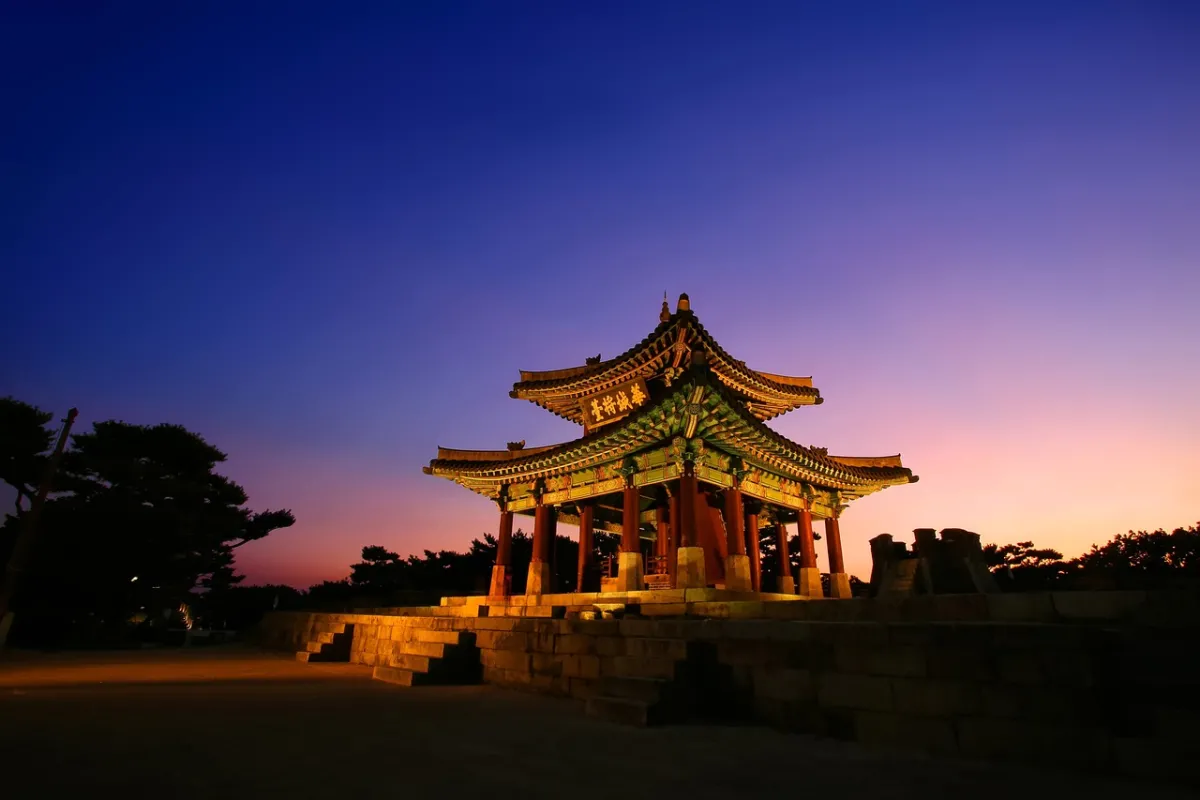
Suwon is the easiest historical day trip from Seoul. You can reach it on Subway Line 1 or the Shinbundang Line, or take a faster train from Seoul Station. At the heart of the city stands Hwaseong Fortress, built at the end of the eighteenth century by King Jeongjo of the Joseon dynasty. Jeongjo planned the fortress partly to honour his father and partly as the centre of a new, modern city. Its construction combined traditional Korean building techniques with new scientific methods of the time, including cranes and pulleys designed by the scholar Jeong Yak-yong. Today the fortress is a UNESCO World Heritage Site.
The fortress wall runs for about 5.7 kilometres around the old city centre, and walking it is the best way to understand its scale. Along the way you will pass grand gates such as Janganmun and Hwaseomun, watchtowers, command posts and the elegant Banghwasuryujeong pavilion, which overlooks a small pond and is one of the most photographed spots in Suwon. Walking the full circuit takes about two to three hours. If that sounds too much, you can walk just one section, for example from Hwaseomun to Banghwasuryujeong, and still get a strong sense of the place.
Inside the walls lies Hwaseong Haenggung, the temporary palace where Jeongjo stayed when he visited Suwon. Its halls and courtyards offer a glimpse of royal life in the Joseon era, and on certain days there are traditional performances and a ceremonial changing of the guard. The surrounding neighbourhood, known as Haenggung-dong, has become a lively area of independent cafés, craft workshops and small galleries in renovated houses.
In the evening the fortress walls are lit up, creating a completely different atmosphere from the daytime. For lunch or dinner, do not miss Suwon galbi, large marinated beef ribs grilled at the table, which the city is famous for. Suwon also has a well-known "chicken street" near the fortress, where restaurants serve crispy whole fried chicken in the old-fashioned style.
Incheon: the history of an open port and the birthplace of jjajangmyeon
Incheon is so close to Seoul that you can reach it simply by riding Subway Line 1 to its terminus at Incheon Station. Right in front of the station lies Korea's largest Chinatown, marked by a colourful traditional gate. The area grew up in the late nineteenth century, when the port opened to foreign trade and Chinese merchants settled here. It is widely regarded as the birthplace of jjajangmyeon, the Korean-Chinese dish of noodles in black bean sauce that Koreans eat on moving days, after graduations and on ordinary weekday lunches.
A small jjajangmyeon museum in Chinatown tells the story of the dish and how it became one of Korea's most popular comfort foods, so you can enjoy food and history together. The streets are lined with restaurants competing to serve the best jjajangmyeon, as well as stalls selling steamed buns, mooncakes and other snacks.
Next to Chinatown is the old open-port district, where banks, warehouses and trading houses from the early modern period still stand. Some have been turned into small museums and cafés, and the area is pleasant for a slow walk. Nearby, Songwol-dong Fairy Tale Village is a residential neighbourhood decorated with colourful murals and sculptures based on famous children's stories, popular with families and photographers.
In the afternoon you can head to Wolmido, a small island connected to the mainland, for a seaside walk and fresh seafood, or travel to Songdo, a planned international district with skyscrapers, canals and Central Park. Watching the lights of Songdo come on at dusk is a striking contrast to the historic streets you saw in the morning.
Gapyeong and Nami Island: an island beautiful in every season
Nami Island became famous across Asia after it appeared as a filming location in a much-loved Korean drama in the early 2000s, and it remains one of the most popular day trips for international visitors. To get there, take the ITX-Cheongchun train or the Gyeongchun Line commuter train to Gapyeong Station, then a short taxi or bus ride to the ferry terminal. A ferry carries you across the river to the island in just a few minutes.
The island itself is small and car-free, crossed by walking paths lined with tall metasequoia, ginkgo and pine trees. Its appeal lies in how dramatically it changes with the seasons: fresh green leaves in spring, deep shade in summer, brilliant red and yellow foliage in autumn and quiet snow-covered avenues in winter. Autumn, especially from mid-October to early November, is the busiest and most photogenic time.
You can walk around the island in two to three hours at a relaxed pace, or rent a bicycle to cover more ground. There are cafés, small galleries and resting spots throughout. The wider Gapyeong area also offers rail bikes along an old railway line, arboretums and riverside parks, so it is easy to fill a whole day here. Because Nami Island lies on the same rail line as Chuncheon, many travellers combine the two in a single day.
The DMZ: facing the reality of a divided peninsula
The Demilitarised Zone, or DMZ, is a strip of land running across the Korean Peninsula on either side of the Military Demarcation Line that separates South and North Korea. It was established at the end of the Korean War in 1953 and remains one of the most heavily fortified borders in the world. Individuals cannot visit freely; you can only see parts of the area through official tours that follow set routes and procedures.
Most tours depart by bus from central Seoul in the morning. Typical stops include Imjingak Nuri Peace Park, a memorial area near the border with monuments and a symbolic bridge; one of the infiltration tunnels dug from the north and discovered in the 1970s; and an observatory from which, on a clear day, you can look directly across into North Korea. Guides explain the history of the war and the decades of division that followed, which gives the visit much of its meaning.
You must bring your passport on any DMZ tour, as there are identity checks. Photography is restricted at some locations because it is a military area, and guides will tell you where you can and cannot take pictures. Depending on the security situation, visits to certain sites may be suspended at short notice, so check the latest information before booking and choose a reputable tour operator. The DMZ is not a glamorous tourist attraction, but it is one of the most thought-provoking places in Korea and a powerful way to understand the country's recent history.
Chuncheon: a city of lakes and dakgalbi
Chuncheon is a pleasant city surrounded by lakes and mountains, reachable from Seoul by train in a little over an hour. For many Koreans, the name alone brings one dish to mind: dakgalbi. Pieces of chicken are stir-fried with cabbage, sweet potato, rice cakes and green onion in a spicy red pepper sauce on a large iron pan at your table. When you have nearly finished, the staff add rice, seaweed and sometimes cheese to the remaining sauce and fry it into a crispy, flavourful fried rice. Many locals say this final rice is the best part.
The other local speciality is makguksu, buckwheat noodles served cold in a tangy broth or with a spicy sauce. It is light and refreshing, making it a good match for the rich dakgalbi, and many restaurants serve both.
After lunch, ride the cable car that crosses the lake for wide views of the city, or walk out onto the Soyang River Skywalk, a glass-floored platform that extends over the water. Cycling or walking along the lakeside paths is another relaxing way to spend the afternoon. Chuncheon has a slower pace than Seoul, which makes it a refreshing break from the capital's crowds.
Gangneung: a KTX trip to the East Sea
Since the high-speed KTX line to the east coast opened, Gangneung has become a city where you can go to see the sea and still be back in Seoul the same evening. In about two hours you can swap city streets for the clear blue water of the East Sea. Gyeongpo Beach is known for its wide stretch of sand backed by pine forest, and nearby Gyeongpo Lake is surrounded by walking and cycling paths.
Gangneung is also famous as one of the centres of Korea's coffee culture. Along Anmok Beach, a long row of cafés faces the sea, many with large windows and rooftop terraces. Coffee shops here are known for roasting their own beans, and spending an hour with a hand-drip coffee while watching the waves is one of the simple pleasures of a visit.
If you are interested in history, visit Ojukheon, the birthplace of the Joseon-era scholar Yi I, known as Yulgok, whose portrait appears on the Korean 5,000-won note. The house is set among distinctive black bamboo. For lunch, head to Chodang village, famous for its soft, silky tofu made using seawater as a coagulant. Sundubu, a soft tofu stew, is the local favourite. Jeongdongjin, a well-known sunrise spot where the railway runs right along the coast, lies a little further from the city and is worth adding if you have time.
Jeonju: hanok village and the home of bibimbap
Jeonju is a city of traditional culture that you can reach from Seoul in roughly two hours by KTX. At its centre lies the Jeonju Hanok Village, where around seven hundred traditional houses with curved tiled roofs line the streets. Many visitors rent hanbok, traditional Korean clothing, from the shops nearby and spend the day wandering the alleys, which gives the area a festive atmosphere at almost any time of year.
Right beside the hanok village stand two of Jeonju's most important landmarks. Gyeonggijeon is a shrine that houses a portrait of King Taejo, the founder of the Joseon dynasty, and its grounds are peaceful and shaded by old trees. Across the road, Jeondong Cathedral is one of the oldest Catholic church buildings in Korea, built in a striking Romanesque style. The contrast between the two sites tells an interesting story about Korea's history.
Jeonju is also known as a city of food. Jeonju bibimbap, rice topped with a colourful arrangement of seasoned vegetables, meat and egg, is the city's signature dish and is often served with a generous spread of side dishes. Kongnamul gukbap, a hot soup of bean sprouts and rice, is a favourite breakfast and hangover cure. In the evening, the night market at Nambu Market offers a wide range of street food and small dishes. Note that the KTX station is some distance from the hanok village, so allow time for a bus or taxi ride in each direction.
Tips for making the most of your day trip
- Book train tickets early: KTX and ITX seats sell out quickly on weekends and holidays. If you are a foreign visitor, check the Korail Pass, which allows unlimited train travel for a set number of days and can be good value if you plan several trips.
- Decide your return train first: Check the last train back and book a comfortable return seat in advance so you can relax during the day.
- Wear comfortable shoes: Fortress walls, islands and hanok villages all involve plenty of walking, sometimes on uneven ground.
- Consider visiting on a weekday: Nami Island and Jeonju Hanok Village become very crowded on weekends, especially in autumn. Weekdays are far calmer.
- Check the weather: Your experience at the DMZ observatories and at the seaside will depend heavily on visibility and conditions.
- Carry some cash: Cards are accepted almost everywhere in Korea, but small market stalls and some ferries or rural buses are easier with cash.
Which day trip suits you?
Every traveller is different, so it helps to match the destination to your interests. If you love history and architecture, Suwon and Jeonju are the most rewarding choices: one offers a monumental fortress, the other an entire neighbourhood of traditional houses. If you are looking for natural scenery and photographs, Nami Island and Chuncheon deliver forests, rivers and lakes within easy reach of the city, while Gangneung is the clear winner for anyone who simply wants to see the sea.
Food lovers can plan a trip around a single dish: jjajangmyeon in Incheon, dakgalbi in Chuncheon or bibimbap in Jeonju. Each city takes real pride in its speciality, and eating it where it was born is part of the experience. For travellers who want to understand Korea's modern history more deeply, a DMZ tour is the most meaningful option, even if it is less relaxing than the others.
Families with young children may prefer Suwon or Incheon, where travel times are short, the subway takes you almost to the door and there are plenty of places to rest. Couples often choose Nami Island in autumn or the cafés of Gangneung, while solo travellers will find every destination on this list safe and easy to navigate alone. Whichever you choose, a day outside Seoul is likely to leave you with a fuller picture of Korea.
Frequently asked questions
Can I do these day trips without a rental car?
Yes. Every destination in this guide can be reached by public transport or official tour. Korean trains and buses are punctual, clean and reasonably priced, and signs at major stations are in English as well as Korean.
Can I visit the DMZ on my own?
No. The main facilities in the DMZ cannot be visited independently; you can only enter through official tours or designated procedures. Bringing your passport is mandatory.
Can I combine two destinations in one day?
Places on the same line, such as Gapyeong and Chuncheon, can be combined in one day. Trying to link destinations that are far apart, however, often means spending most of the day in transit. In most cases it is better to enjoy one city at a relaxed pace.
Which day trip is best in autumn?
Nami Island is famous for autumn foliage, and Suwon's fortress walls are especially beautiful under clear autumn skies. Both are very popular from mid-October to early November, so go early in the day.
Final thoughts: another Korea beyond Seoul
If Seoul shows you Korea's present, the places around it show you its history, its landscapes and its regional flavours. A day spent walking a fortress wall, strolling through island forests or gazing at the East Sea will add depth to any trip to Seoul. If you have even one spare day in your itinerary, use this guide to plan a small adventure beyond the city. You may find that it becomes one of the highlights of your journey.