Busan Travel Guide: A 3-Day Itinerary of Beaches, Markets, Hillside Villages and Food
The seas of Haeundae and Gwangalli, the colourful alleys of Gamcheon Culture Village, the bustle of Jagalchi Market — a guide for first-time visitors to Busan with neighbourhoods, a three-day route, must-eat foods and transport tips.

Contents
- What kind of city is Busan?
- Getting to Busan
- Getting around Busan
- Busan by area: three zones
- Day 1: Old Busan in the original downtown
- Day 2: The seas of Haeundae and Gijang
- Day 3: Gwangalli by night and Yeongdo's alleys
- Busan on screen
- Day trips from Busan
- Foods you must try in Busan
- Where to stay
- Busan by season
- A taste of the Busan dialect
- Budget and practical tips
- Busan's festivals
- Busan on a rainy day
- Frequently asked questions
- Final thought: a city that resembles the sea
If Seoul shows you Korea today, Busan is where you feel Korea's sea and its people most vividly. Korea's second city and largest port, Busan packs beaches lined with skyscrapers, old villages clinging to hillsides and a seafood market that's busy from dawn into a single city. With the KTX it's less than three hours from Seoul, making it the most visited city in Korea after the capital for many foreign travellers.
Busan stretches out between mountains and sea, so its sights are spread across several districts. List everywhere you want to go without a plan and you can easily spend a whole day in transit. In this guide we divide Busan into three main areas and suggest an efficient three-day route for first-time visitors, along with the Busan foods you must try and information on transport, accommodation and seasonal festivals.
What kind of city is Busan?
Busan sits at the south-eastern tip of the Korean peninsula and has about 3.3 million people. It developed early as a trading port, and during the Korean War it served as the temporary capital, drawing refugees from across the country. Hillside neighbourhoods such as Gamcheon Culture Village and markets such as Gukje Market carry the history of that period.
Today Busan is a seaside tourism city and a film city too. The Busan International Film Festival, held every autumn, has become one of Asia's leading film festivals, and countless Korean films and dramas have been shot here. The strong, punchy Busan dialect is part of the city's charm as well. It can sound angry the first time you hear it, but it's full of warm, straightforward expressions.
Getting to Busan
KTX
The most convenient way from Seoul is the KTX high-speed train. Seoul Station to Busan Station takes around two and a half hours depending on the train, with dozens of departures a day. Busan Station is in the old downtown, handy for Nampo-dong, Jagalchi Market and Gamcheon Culture Village. Tickets sell out quickly at weekends and holidays, so book ahead on the Korail app or website. Foreign visitors can also use passes that allow unlimited KTX travel for a set period.
By air
Domestic flights from Gimpo to Gimhae International Airport take about an hour. Gimhae also has international flights to Japan, China, Southeast Asia and elsewhere, so you can fly into Busan directly from abroad. The airport is connected to the city by light rail, subway and limousine buses.
Express bus
If you want to save money, express buses are a good choice. The trip from Seoul takes four to five hours, but premium buses have wide seats for a comfortable ride.
Getting around Busan
Busan has subway lines 1 to 4, the Donghae Line commuter rail running along the coast, and the Busan-Gimhae light rail. The transport card you used in Seoul works in Busan too. But Busan is hilly and some sights are some distance from subway stations, so combine the subway with buses and taxis. For places such as Gamcheon Culture Village and Haedong Yonggungsa that aren't directly on the subway, use village buses or taxis.
As in Seoul, Naver Map and KakaoMap are the most accurate map apps. Taxis are easy to call with the Kakao T app, and short trips aren't expensive.
Busan by area: three zones
| Area | Main sights | Atmosphere |
|---|---|---|
| Old downtown (Jung-gu, Seo-gu, Saha-gu) | Jagalchi Market, Gukje Market, BIFF Square, Gamcheon Culture Village, Yongdusan Park | Old Busan's history and market energy |
| Haeundae and Gijang | Haeundae Beach, Blueline Park, Haedong Yonggungsa, Dalmaji-gil | Polished beach resorts and sea views |
| Suyeong, Gwangalli and Seomyeon | Gwangalli Beach, Gwangan Bridge, Seomyeon, Jeonpo Café Street | Night views, cafés and a young vibe |
Day 1: Old Busan in the original downtown
Morning: Gamcheon Culture Village
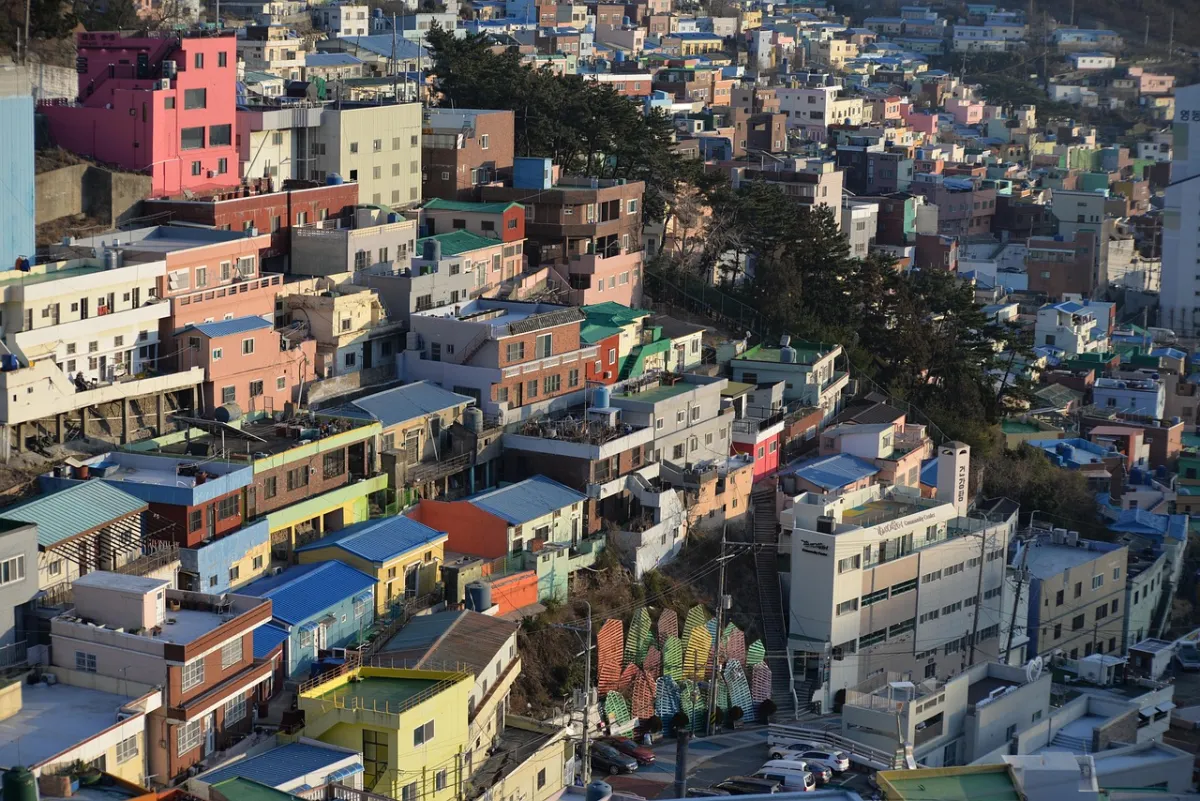
Start your first day in the old downtown near Busan Station. In the morning, head to Gamcheon Culture Village, nicknamed "the Machu Picchu of Korea" and "the Santorini of Korea". It grew up during the Korean War, when refugees built houses in terraces up the hillside, and took on its colourful look after residents and artists began a village regeneration project around 2009.
Murals and sculptures are hidden throughout the alleys, and following the map on a "stamp tour" is part of the fun. The Little Prince statue gazing over the village is always surrounded by people waiting for photos. Remember that residents still live here, so don't peer into homes or make noise.
Lunch: Jagalchi Market
Come down from Gamcheon and head to Jagalchi Market, one of Korea's largest seafood markets. From early morning the seaside stalls overflow with fresh fish, shellfish and octopus. The usual system is to choose seafood on the ground floor and have it prepared as raw fish or grilled at a restaurant upstairs. Just hearing the booming voices of the market traders — the famous "Jagalchi ajime" — makes you feel you've truly arrived in Busan.
Afternoon: Gukje Market and BIFF Square
Right opposite Jagalchi are Gukje Market and Kkangtong Market. They grew from the trading of refugees after the Korean War and gave their name to the film Ode to My Father (known in Korean as Gukje Market). It's a maze-like market selling everything from clothes, sundries and imported goods to street food.
Nearby BIFF Square was created in the Nampo-dong cinema district where the Busan International Film Festival began, and the pavement is set with the handprints of famous film figures. Its signature snack is ssiat hotteok, seed-filled pancakes: hotteok fried until crisp, split open and stuffed with sunflower seeds, peanuts and other nuts. Warm and nutty, it always draws a queue.
Evening: Yongdusan Park and Busan Tower
Around sunset, climb to Yongdusan Park and look out over the old downtown and harbour from Busan Tower. The lights of Nampo-dong and the Busan Harbor Bridge spread out before you.
Day 2: The seas of Haeundae and Gijang
Morning: Haedong Yonggungsa
On day two, head east to Haeundae and Gijang. We recommend visiting Haedong Yonggungsa early in the morning. Unlike most Korean temples, which are tucked away in the mountains, it sits on rocks right beside the sea, so you can explore it to the sound of the waves. It's also a famous sunrise spot, and going early means fewer visitors and a more tranquil atmosphere.
Lunch and afternoon: Blueline Park and Haeundae
On the way back to Haeundae, don't miss Haeundae Blueline Park. Built on the old Donghae Nambu Line railway, it has a "beach train" running along the coast from Mipo to Songjeong and "sky capsules" — small two- to four-person pods gliding slowly along an elevated rail above the sea. The colourful sky capsules make wonderful photos with the ocean behind them and are very popular, so book in advance.
In the afternoon, stroll along Haeundae Beach, Korea's most famous beach. About 1.5 km of sand with skyscrapers rising behind it creates a unique scene. The swimming season usually runs in summer, but beach walks and seaside cafés are lovely in any season. At nearby Haeundae Traditional Market you can try fish cakes, tteokbokki and grilled hagfish.
Evening: Dalmaji-gil or an observatory
Dalmaji-gil, on the hill east of Haeundae, is a road of walking paths overlooking the sea and atmospheric cafés. Looking down on Haeundae's night lights from a high-rise observatory is another great way to end the day.
Day 3: Gwangalli by night and Yeongdo's alleys
Morning: Huinnyeoul Culture Village, Yeongdo
On your last morning, head to Yeongdo, an island just south of the old downtown. Huinnyeoul Culture Village is a row of small houses on a cliff facing the sea; its white walls against the blue water have earned it the nickname "the Santorini of Busan". It's also known as a filming location for the film The Attorney. Walk the coastal path at the foot of the cliff and you'll see large ships anchored offshore. Nearby Taejongdae, with its dense forest, coastal cliffs and lighthouse, is one of Busan's best-known natural attractions.
Afternoon: Jeonpo Café Street and Seomyeon
In the afternoon, move to Seomyeon, Busan's main downtown. Packed with malls, restaurants and bars, it also has long underground shopping arcades that are handy on rainy days. Nearby Jeonpo Café Street was once an alley of hardware shops; as distinctive cafés and bakeries moved in one by one, it became Busan's best-known café street.
Evening: Gwangalli and the Gwangan Bridge
Spend your final night in Gwangalli. Gwangan Bridge, spanning the sea in front of Gwangalli Beach, glows with dazzling lights after dark and creates Busan's iconic night view. Sitting at one of the cafés, raw-fish restaurants or bars along the beach and having dinner while looking at the bridge is a favourite evening for locals.
Gwangalli also regularly hosts drone light shows in which hundreds of drones draw pictures in the night sky. Schedules vary by season and circumstances, so check the official information before you go. In autumn, a huge fireworks festival around Gwangalli draws crowds from all over the country.
Busan on screen
Busan is one of the favourite filming locations of Korean cinema and television. Watch a few titles before you go and the same places will feel far more special.
- Ode to My Father (2014): a film about the life of a man who settled in Busan after the Korean War; inside Gukje Market there's a spot commemorating the shop from the film.
- The Attorney (2013): Huinnyeoul Culture Village on Yeongdo was a key location, and you can find traces of the film around the village.
- Haeundae (2009): a disaster film in which a giant tsunami hits Haeundae, set around the beach district.
- Pachinko: the drama based on the novel of the same name begins its story on Yeongdo in Busan. Walking around the island imagining its sea and old harbour in that era is a meaningful experience.
During the Busan International Film Festival, screenings and outdoor stage events centre on the Busan Cinema Center, so film lovers may want to time their visit accordingly.
Day trips from Busan
If you have time to spare, using Busan as a base to explore nearby towns is well worth it.
- Gyeongju: the thousand-year capital of the Silla kingdom, just over 30 minutes from Busan by KTX. Packed with UNESCO World Heritage sites such as Bulguksa Temple, the Daereungwon tomb complex and Cheomseongdae observatory, it's a very popular day trip.
- Tongyeong and Geoje: beautiful islands and seascapes on the south coast, about 90 minutes to two hours by bus. Tongyeong's cable car and Geoje's coastal drives are famous.
- Tongdosa Temple, Yangsan: one of Korea's most important temples and part of the UNESCO World Heritage site "Sansa, Buddhist Mountain Monasteries in Korea". It's reachable by bus from central Busan.
Gyeongju in particular combines well with a Busan trip: many travellers add a night there, turning a three-day Busan visit into a five-day tour of Korea's south-east.
Foods you must try in Busan
| Food | What it is | Where |
|---|---|---|
| Dwaeji gukbap | Busan's soul food: rice and pork in a milky broth made from pork bones | Seomyeon, around Busan Station |
| Milmyeon | Busan-style cold noodles made with wheat flour and starch in chilled broth | Milmyeon specialists across the city |
| Ssiat hotteok | Crispy sweet pancakes stuffed with nuts and seeds | BIFF Square |
| Eomuk (fish cake) | Busan is the home of Korean fish cake, in many shapes and in soup | Markets, fish cake shops |
| Hoe (raw fish) | Fresh raw fish with chilli sauce or lettuce wraps | Jagalchi Market, Millak-dong raw fish centre |
| Nakgopsae | Spicy hot pot with small octopus, beef intestines and prawns | Hot pot restaurants in the city |
| Bibim dangmyeon | Glass noodles mixed with vegetables and sauce, a market snack | Gukje Market food alley |
How to enjoy dwaeji gukbap
Taste the broth on its own first, then season to taste with salted shrimp and add seasoned chives. A spoonful of spicy paste (dadaegi) gives it a kick. Some places serve the rice separately for you to add, others bring it already in the soup, so check when you order.
The birth of milmyeon
Milmyeon is said to have begun during the Korean War, when refugees from the north who had fled to Busan longed for the cold noodles of home. Unable to find buckwheat, they made noodles from wheat flour received as relief supplies. It's a dish steeped in Busan's history, so if you visit in summer, be sure to try it.
Where to stay
- Haeundae: plenty of sea-view hotels and resorts for a relaxing break, and convenient for Blueline Park and Haedong Yonggungsa.
- Gwangalli: many rooms with views of the illuminated Gwangan Bridge, with cafés and restaurants close by for evenings out.
- Seomyeon: the transport hub where subway lines 1 and 2 meet, convenient for everywhere and relatively affordable.
- Nampo-dong / Busan Station: handy if you arrive by KTX or plan to focus on the old downtown and markets.
For a three-day trip, a split stay — the first night near Busan Station or Nampo-dong and the remaining nights in Haeundae or Gwangalli — is a good way to cut down on travel.
Busan by season
- Spring: when cherry blossoms bloom in late March and early April, Dalmaji-gil and the Namcheon-dong blossom road are beautiful.
- Summer: the beaches open and seaside festivals take place. Haeundae gets extremely crowded, so aim for early mornings or evenings.
- Autumn: Busan's best season, with the film festival and the Gwangalli fireworks festival. Accommodation fills up fast, so book early.
- Winter: milder than much of Korea, Busan is a popular winter seaside destination, and Haeundae sometimes hosts a year-end light festival.
A taste of the Busan dialect
In Busan you'll hear an accent and expressions very different from standard Seoul Korean. Knowing a few makes chatting with market traders more fun.
- "Mai mura": "eat lots!" — often said when offering food.
- "Wa?": "why?"
- "Aida": "no / that's not it".
- "Eoksuro": "very, really", as in "eoksuro masitda" (really delicious).
- "Goma": "just" or "that's enough", used in many ways depending on context.
Busan dialect has strong, clipped endings and can sound brusque at first, but it reflects the warm-hearted, frank character of Busan people.
Budget and practical tips
Prices in Busan are similar to or slightly lower than Seoul's. Seafood chosen at the market can be reasonably priced, but it's often sold at market price, so always check the price before ordering.
- Comfortable shoes: Gamcheon and Huinnyeoul villages have lots of stairs and slopes.
- Be ready for wind: it's often breezy by the sea, so bring a light jacket.
- Book ahead: Blueline Park sky capsules, popular restaurants and festival-season accommodation are best reserved in advance.
- Try a spa: there are large spa facilities near Haeundae — perfect after a day in the sea breeze.
Busan's festivals
Busan hosts festivals large and small all year round. In autumn, the Busan International Film Festival, one of Asia's leading film festivals, fills Haeundae and the Busan Cinema Center area with film fans and audiences. The fireworks festival, which lights up the sea with spectacular displays against the backdrop of Gwangan Bridge, is another event many people look forward to; accommodation and restaurants around Gwangalli Beach get booked up early, so plan ahead. In summer, each beach holds a sea festival, and the area around Jagalchi Market sometimes hosts seafood-themed festivals. Before fixing your travel dates, check festival schedules on the Busan tourism website.
Busan on a rainy day
No need to be disappointed if it rains on the day you planned to see the sea; Busan has plenty to enjoy indoors. Large department stores and malls with spas, ice rinks and cinemas are great for spending half a day, and the aquarium or museums in Haeundae are good choices too. Rain-soaked Gamcheon Culture Village or Yeongdo's alleys can reveal a calm atmosphere quite different from sunny days. Sitting by the window of a sea-view café with a cup of hot tea, watching waves in the rain, can become one of the unforgettable moments of your Busan trip.
Frequently asked questions
Can I do Busan as a day trip?
A day trip from Seoul by KTX is possible, but the sights are spread out and you'll likely leave wanting more. We recommend at least one night, ideally two.
Can I swim in the sea in Busan?
During the official summer beach season you can swim in zones with lifeguards. Opening dates and hours are announced each year, so check before you go.
Where should I go on a rainy day?
Large department stores and spas, Seomyeon's underground arcades and the Busan Museum of Art are good indoor options. Jagalchi Market has its own charm in the rain, too.
Final thought: a city that resembles the sea
Busan is a city where glamorous beach resorts, alleys holding the history of wartime refugees, the energy of a dawn market and the lights of the night sea all exist together. Seeing every sight on your list is great, but sitting on a beach bench listening to the waves, or sharing a brief chat with a market trader, may be what stays with you longest.
A day that begins with a bowl of dwaeji gukbap and ends with the lights of Gwangan Bridge — that's how Busan welcomes travellers, humble and dazzling at once.