Korean Pancakes (Jeon and Buchimgae) Explained: Pajeon, Kimchijeon, Bindaetteok, Holiday Jeon, Rainy-Day Culture and a Seafood Pancake Recipe
Crispy at the edges, soft in the middle and best eaten hot from the pan, Korean pancakes are one of the most loved dishes in Korean home cooking. This guide explains the difference between jeon and buchimgae, the most popular types from seafood pajeon to mung bean bindaetteok, why Koreans crave pancakes on rainy days, how they are served at holidays, and how to make a crisp seafood pancake at home.

Contents
- Jeon, buchimgae, jijimgae: what is the difference?
- What makes a Korean pancake different?
- The most popular Korean pancakes
- A quick comparison of common pancakes
- Rain, pancakes and makgeolli
- Jeon at holidays and ancestral rites
- Understanding the batter
- Recipe: crispy seafood and green onion pancake (haemul pajeon)
- Seven tips for an extra-crispy pancake
- Easy variations to try at home
- Where to eat Korean pancakes in Korea
- Pancake culture in modern Korea
- Storing and reheating
- A note on ingredients and allergies
- Frequently asked questions
- Final thought: a dish that brings people together
Listen to the sound of oil sizzling in a wide pan on a rainy afternoon in Korea and you will understand something about the country's food culture that no menu can explain. Korean pancakes, known as jeon (전) or buchimgae (부침개), are not a dessert and have nothing to do with maple syrup. They are savoury, golden, often studded with green onions, seafood or kimchi, and they are made to be torn apart with chopsticks and dipped into a tangy soy sauce. They appear at family holidays, in market alleys, at university pubs and in home kitchens whenever the weather turns grey.
In this guide we look at what makes a Korean pancake, the difference between the many names you will hear, the most popular varieties, the role of pancakes during holidays and ancestral rites, the famous link between rain and pancakes, and a detailed recipe for a crispy seafood pancake that you can make in an ordinary kitchen.
Jeon, buchimgae, jijimgae: what is the difference?
Visitors are often confused by the number of words Koreans use for pancakes. In everyday speech the boundaries are loose, but there are some useful distinctions.
- Jeon (전) is the broadest term. It covers any ingredient that is thinly coated in flour and egg, or mixed into a batter, and then pan-fried in a little oil. Jeon can be a large pancake, but it can also be small bite-sized pieces such as slices of zucchini or fish fillet dipped in egg.
- Buchimgae (부침개) comes from the verb buchida (부치다), meaning to pan-fry something flat. It usually refers to a big, round pancake made with a batter, such as a green onion or kimchi pancake. Many people use the word at home, and it sounds warm and casual.
- Jijimgae (지짐개) or jijim (지짐) is a regional and older word with a similar meaning, heard especially in some southern dialects and in certain dish names such as bindae-jijim.
In practice, a restaurant might write haemul pajeon on the menu while a grandmother at home says she is "making buchimgae". Both are talking about essentially the same delicious thing, so there is no need to worry too much about the exact label.
What makes a Korean pancake different?
Korean pancakes share a few features that set them apart from pancakes in other cuisines.
- They are savoury. The batter is lightly salted and never sweetened. The flavour comes from the vegetables, seafood, meat or kimchi inside.
- The filling is the star. The batter acts mainly as glue. A good green onion pancake is mostly green onion, with just enough batter to hold the stalks together.
- Texture matters. Most Koreans love a pancake with crispy, lacy edges and a tender, chewy centre. The contrast is part of the pleasure.
- They are shared. A large pancake is placed in the middle of the table, often cut into squares or wedges with scissors, and everyone picks pieces with chopsticks.
- They come with a dipping sauce. A simple mix of soy sauce and vinegar, sometimes with chilli flakes, sesame seeds or onion, balances the richness of the oil.
The most popular Korean pancakes
There are dozens of regional and seasonal varieties, but these are the ones you are most likely to meet.
Pajeon (파전): green onion pancake
Pajeon is the classic. Long stalks of green onion or scallion are laid side by side in the pan and covered with a thin batter. When seafood is added it becomes haemul pajeon (해물파전), the version most often found in restaurants, filled with squid, shrimp, clams or oysters. Dongnae in Busan is famous for Dongnae pajeon, a thick, soft style traditionally made with a batter that includes rice flour and egg, poured over green onions and seafood.
Kimchijeon (김치전): kimchi pancake
Kimchijeon is the ultimate home pancake. Chopped well-fermented kimchi is mixed into the batter, often with a little kimchi juice for colour and tang, and sometimes with pork, tuna or onion. It is a clever way to use kimchi that has become too sour to eat on its own. The result is red-orange, spicy, slightly sour and very satisfying.
Bindaetteok (빈대떡): mung bean pancake
Bindaetteok is made not from wheat flour but from soaked mung beans ground into a thick batter, mixed with ingredients such as bean sprouts, kimchi, fernbrake and minced pork. It is fried in generous oil until thick and crunchy on the outside. Gwangjang Market in Seoul is famous for its bindaetteok stalls, where huge stone mills grind the beans in front of customers and the pancakes sizzle on wide griddles.
Gamjajeon (감자전): potato pancake
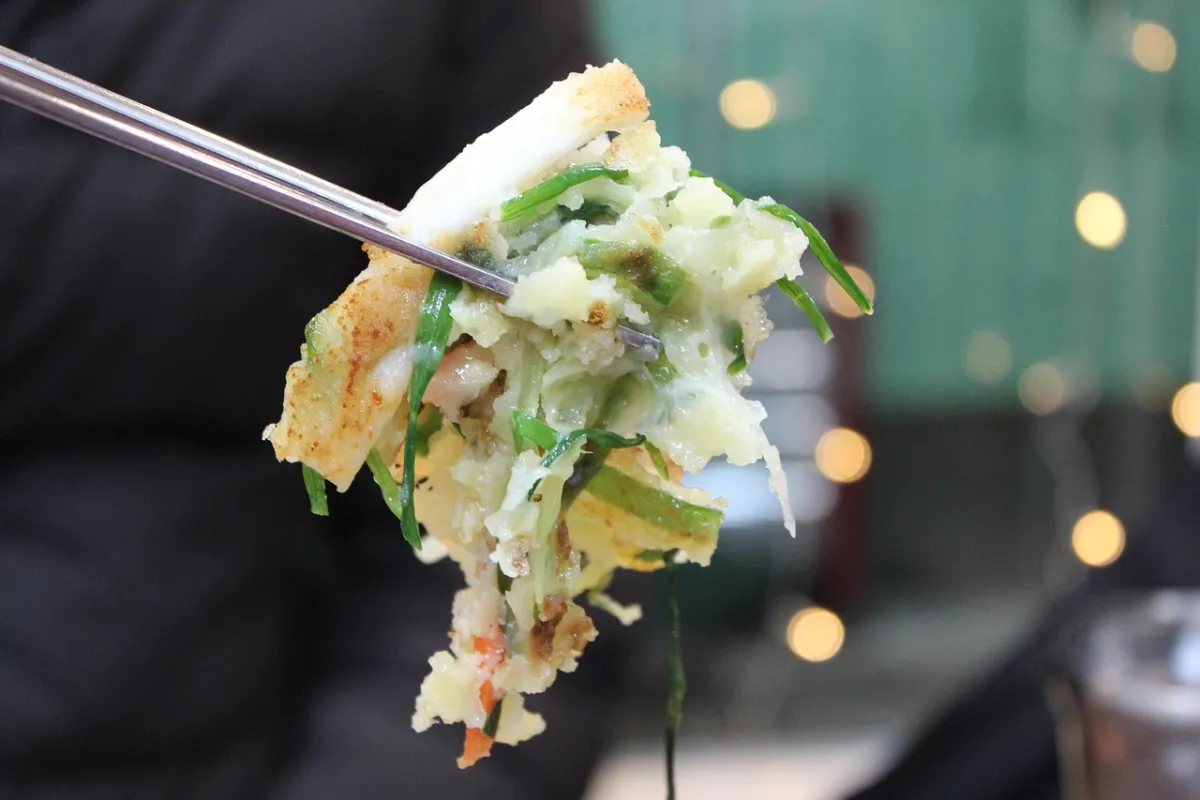
A specialty of Gangwon Province, where potatoes have long been a staple. Raw potatoes are finely grated, lightly drained and fried with almost no other ingredients. The pancake is chewy, slightly translucent and has a gentle, natural sweetness.
Hobakjeon (호박전) and other vegetable jeon
Slices of Korean zucchini (aehobak) are salted, coated in flour and dipped in beaten egg before being fried. Similar techniques are used for mushrooms, peppers and sweet potatoes. These small jeon are common side dishes and are always present at holiday tables.
Saengseonjeon (생선전) and donggeurang-ttaeng (동그랑땡)
Saengseonjeon is made from thin fillets of mild white fish, coated in flour and egg. Donggeurang-ttaeng are small round patties of minced meat and tofu mixed with vegetables, dipped in egg and fried. The playful name sounds like something round rolling along, and children usually love them.
Buchujeon (부추전) and other regional pancakes
In the southern region of Gyeongsang, garlic chives are called jeongguji, and a thin, crisp chive pancake is a summer favourite. On Jeju Island, buckwheat crepes called bingtteok are rolled around seasoned radish. Every region has its own twist, which makes pancakes a fun way to explore Korean regional food.
A quick comparison of common pancakes
| Pancake | Main ingredient | Texture | Typical occasion |
|---|---|---|---|
| Haemul pajeon | Green onion, seafood, wheat batter | Crisp edges, soft centre | Restaurants, rainy days |
| Kimchijeon | Fermented kimchi, wheat batter | Crispy, spicy, tangy | Home cooking, snacks |
| Bindaetteok | Ground mung beans, sprouts, pork | Thick, crunchy outside | Markets, holidays |
| Gamjajeon | Grated potato | Chewy, mildly sweet | Gangwon specialty |
| Hobakjeon | Zucchini, flour, egg | Soft, light | Side dish, holidays |
| Donggeurang-ttaeng | Minced meat, tofu, vegetables | Tender, juicy | Holidays, lunch boxes |
Rain, pancakes and makgeolli
Ask almost any Korean what they want to eat on a rainy day and the answer will probably be pancakes, usually with a bowl of makgeolli (막걸리), the milky, lightly sparkling rice wine. Search interest in pancake recipes and sales of pancake flour and makgeolli are often reported to rise during the rainy season.
Why rain? There are several popular explanations, and none of them can be proven, which is part of the fun.
- The sound. Many people say that the crackle of batter in hot oil sounds like raindrops hitting the ground, so the rain naturally reminds them of pancakes.
- Comfort. Hot, oily food feels cosy when the air is damp and cool, and pancakes are easy to make with ingredients already in the house.
- Tradition. In the past, farmers could not work in the fields on rainy days. Families stayed home and made something simple and filling to share, and pancakes fitted perfectly.
- Atmosphere. A rainy evening with friends, a hot pancake and a kettle-shaped bowl of makgeolli is a scene that appears again and again in Korean dramas and songs, reinforcing the idea.
Whatever the reason, the pairing works. The slight acidity and fizz of makgeolli cut through the oil, while the pancake softens the alcohol. Pubs near universities and in old neighbourhoods often specialise in this combination. Areas such as Jeon Street near Hoegi Station in Seoul, sometimes called "pajeon alley", became popular student hangouts for exactly this reason. If you prefer not to drink alcohol, barley tea or a fizzy drink is just as common at the table.
Jeon at holidays and ancestral rites
During Seollal (Lunar New Year) and Chuseok (the autumn harvest festival), families traditionally prepare large amounts of jeon. Plates of hobakjeon, saengseonjeon, donggeurang-ttaeng and colourful skewers called sanjeok are arranged for the ancestral memorial table (charye) and shared with relatives.
Frying jeon for a big family can take hours, and the job has long been associated with the women of the household. In recent years many families have changed this. Men, children and every generation now join in, families buy part of the jeon from markets, or they simplify the menu. The Korean term myeongjeol jeunghugun (명절 증후군), or "holiday syndrome", is often linked in the media to the stress of long hours in the kitchen, and conversations about sharing the work fairly have become a familiar part of modern holiday culture.
For many people, though, the smell of jeon in the apartment hallway is the smell of the holidays themselves. Picking hot pieces straight from the plate while the cooking is still going on is a favourite childhood memory.
Understanding the batter
The batter is simple, but small choices make a big difference.
- Buchim garu (부침가루). Korean pancake mix, sold in every supermarket, is wheat flour pre-seasoned with salt, garlic or onion powder and a raising agent. It is the easiest choice for beginners.
- Twigim garu (튀김가루). Korean frying mix. Many cooks blend it half-and-half with pancake mix for a crispier result.
- Plain flour plus starch. If you cannot find Korean mixes, use plain flour with a few spoons of potato starch or cornstarch, a pinch of salt and a little baking powder.
- Rice flour. Adding some rice flour gives a lighter, crispier texture and is used in some traditional styles.
- Very cold water. Ice-cold water slows gluten development and helps create a crisp crust. Some cooks even add an ice cube to the batter.
- Egg (optional). Egg makes the pancake softer and richer but less crispy. Restaurant seafood pancakes are often finished with a beaten egg poured over the top.
The golden rule is not to overmix. Stir just until the flour disappears. A few small lumps are fine, and an overworked batter becomes chewy and heavy.
Recipe: crispy seafood and green onion pancake (haemul pajeon)
This recipe makes two medium pancakes, enough for two to three people as a main dish or four as a snack.
Ingredients
- 1 bunch of green onions (about 10 to 12 stalks), or Korean jjokpa if available
- 150 g mixed seafood: squid, small shrimp, clams or a frozen seafood mix, thawed and patted dry
- ½ red chilli and ½ green chilli, thinly sliced (optional)
- 1 cup (about 120 g) Korean pancake mix, or 100 g plain flour plus 20 g potato starch, ½ tsp salt and ¼ tsp baking powder
- About ¾ to 1 cup (180–220 ml) ice-cold water
- 1 egg, beaten (optional, for the top)
- Neutral cooking oil, generously
Dipping sauce
- 2 tbsp soy sauce
- 1 tbsp rice vinegar or apple vinegar
- 1 tbsp water
- ½ tsp sugar (optional)
- A pinch of red chilli flakes (gochugaru), a few sesame seeds and some finely chopped onion
Method
- Prepare the vegetables. Wash the green onions and dry them well. Cut them to fit the width of your pan, and split thick white parts lengthwise so they cook evenly.
- Prepare the seafood. Cut squid into thin strips and shrimp into small pieces. Dry everything thoroughly with kitchen paper; extra water makes the pancake soggy.
- Make the batter. Mix the flour with the ice-cold water until just combined. It should be slightly thinner than crepe batter, flowing easily from a spoon.
- Heat the pan. Use a wide non-stick or well-seasoned pan over medium-high heat with about 3 tablespoons of oil. The oil should shimmer before anything goes in.
- Lay the green onions. Arrange half of the green onions in a single layer, side by side. Pour a thin layer of batter over them, just enough to fill the gaps.
- Add the seafood. Scatter half of the seafood and chilli slices over the top, then drizzle a little more batter to cover them. If you like, pour half of the beaten egg over the surface.
- Fry the first side. Cook for 3 to 4 minutes, shaking the pan now and then, until the bottom is deep golden and the edges look crisp. Add a little oil around the edges if the pan looks dry.
- Flip. Turn the pancake with a wide spatula, or slide it onto a plate and invert it back into the pan. Press gently and add another tablespoon of oil around the edge.
- Finish. Fry for another 3 minutes until crisp. Flip once more for 30 seconds if you want extra crunch.
- Serve. Slide onto a board, cut into squares and serve immediately with the dipping sauce. Repeat with the remaining ingredients.
Seven tips for an extra-crispy pancake
- Use more oil than you think. Korean pancakes are shallow-fried, not dry-fried. Enough oil is what creates the lacy edges.
- Keep the batter thin. Thick batter makes a doughy pancake. Let the vegetables dominate.
- Keep everything cold and dry. Cold batter and dry ingredients give the crispiest result.
- Do not crowd the pan. Make two thinner pancakes rather than one thick one.
- Be patient before flipping. If the pancake sticks, it is not ready yet. A well-fried base releases on its own.
- Press lightly, not hard. Pressing too much squeezes out steam and can make it dense.
- Eat it right away. Pancakes lose their crispness within minutes, which is why Koreans eat them straight from the pan.
Easy variations to try at home
- Kimchijeon: mix 1 cup of chopped sour kimchi and 2 tablespoons of kimchi juice into the batter, with thin strips of pork or a little canned tuna. Reduce the salt.
- Vegetable pancake (yachaejeon): use thinly sliced onion, carrot, zucchini and potato. It is a great way to clear out the fridge.
- Chive pancake (buchujeon): use garlic chives instead of green onions and add a few slices of chilli for colour.
- Potato pancake (gamjajeon): finely grate 2 potatoes, squeeze out some liquid, let the starch settle, then mix the starch back in with a pinch of salt and fry in small rounds.
- Vegan option: skip the egg and seafood, and use mushrooms, zucchini and green onion with a flour-and-starch batter.
Where to eat Korean pancakes in Korea
- Traditional markets. Gwangjang Market in Seoul is known for its bindaetteok and assorted jeon platters, and many local markets have stalls selling jeon by weight.
- Makgeolli pubs. Look for signs that say jeonjip (전집, pancake house) or makgeolli-jip. Many offer a modeum-jeon (모둠전), an assorted pancake platter.
- Busan's Dongnae area. Try the thick, soft Dongnae pajeon in the neighbourhood where it became famous.
- Gangwon Province. Potato pancakes and buckwheat dishes are local specialties in cities such as Chuncheon and Gangneung.
- Department store food halls. Around Seollal and Chuseok, food halls sell beautifully arranged boxes of holiday jeon.
Pancake culture in modern Korea
Korean pancakes have kept up with modern life. Supermarkets sell frozen pancakes that can be crisped in an air fryer, and delivery apps offer pancake-and-makgeolli sets for rainy evenings. Cafés and modern pubs experiment with cheese, corn or truffle oil, and some restaurants serve elegant bite-sized jeon as part of a Korean tasting menu.
At the same time, the traditional versions remain strong. Family recipes for holiday jeon are passed down, and street stalls still fry bindaetteok in the same way they did decades ago. Like much of Korean food, pancakes connect everyday convenience with deep tradition.
Storing and reheating
Leftover pancakes can be cooled, wrapped and kept in the refrigerator for a day or two. To bring back the crunch, avoid the microwave, which makes them soggy. Instead, reheat them in a dry frying pan over medium heat, or in an air fryer or oven, until hot and crisp again. Holiday jeon are often reheated this way, and some families turn leftovers into jeon-jjigae (전찌개), a spicy stew in which the pancakes soak up a rich broth. As with all seafood dishes, eat leftovers containing seafood promptly and follow basic food safety practices.
A note on ingredients and allergies
Korean pancakes usually contain wheat, and many contain egg, seafood or shellfish. Kimchi may include fish sauce or salted shrimp. If you have food allergies or dietary restrictions, ask about the ingredients when ordering in Korea; useful words are milgaru (밀가루, wheat flour), gyeran (계란, egg), saeu (새우, shrimp) and haemul (해물, seafood). Mung bean or potato pancakes may be options for those avoiding wheat, but check whether wheat flour has been added.
Frequently asked questions
Are Korean pancakes the same as Chinese scallion pancakes?
No. Chinese scallion pancakes are usually made from a laminated dough that is rolled, coiled and pan-fried, giving flaky layers. Korean pajeon is made from a runny batter poured over whole green onions, so it is thinner, softer in the middle and full of visible vegetables.
Why is my pancake soggy?
The most common reasons are too little oil, a pan that is not hot enough, a batter that is too thick or ingredients that were not dried well. Try more oil, higher heat, ice-cold water and thinner layers.
Can I make pancakes without Korean pancake mix?
Yes. Plain flour with some potato starch or cornstarch, salt, a little baking powder and very cold water works well. Adding a spoonful of rice flour makes it even crispier.
What do Koreans drink with pancakes?
Makgeolli is the classic partner, especially on rainy days. Soju and beer are also common. Non-alcoholic choices such as barley tea, sikhye or soft drinks are perfectly normal too.
Are pancakes a main dish or a side dish?
Both. A big seafood pancake can be a meal or a shared snack with drinks, while small jeon such as hobakjeon are served as side dishes. At holidays, jeon are one part of a large spread.
Which pancake should a beginner try first?
Haemul pajeon is the most widely available and least spicy. If you enjoy bold flavours, kimchijeon is a must, and bindaetteok at a traditional market is an experience in itself.
Final thought: a dish that brings people together
Korean pancakes are humble food. They are made from green onions, a handful of seafood, leftover kimchi or a few potatoes, held together by a simple batter. Yet they carry a surprising amount of meaning: the sound of rain, the warmth of a crowded pub, the busy kitchen before a holiday, the laughter of a family gathered around one big plate. The next time the sky turns grey, heat a pan, pour in a thin batter and listen to the sizzle. You will be taking part in one of Korea's most comforting food traditions.