Korean Juk (Rice Porridge) Explained: Hobakjuk, Jeonbokjuk, Patjuk, Yachaejuk and Dakjuk, Juk Restaurants, Comfort-Food Culture, Side Dishes and Two Home Recipes
Juk, Korean rice porridge, is the gentle bowl Koreans reach for on cold mornings, slow recovery days and quiet family meals. This guide explains what juk is, how it differs from congee and other grain dishes, the most popular types from golden pumpkin hobakjuk to abalone jeonbokjuk, how juk restaurants work, which side dishes go with it, and how to make pumpkin and vegetable juk at home.

Contents
- What Is Juk?
- Juk Compared with Congee and Other Rice Porridges
- A Short History of Juk in Korea
- The Most Popular Types of Juk
- Juk at a Glance
- Juk as Comfort Food
- How Juk Restaurants Work
- What to Eat with Juk: Side Dishes
- How to Eat Juk: Small Etiquette Tips
- Basic Principles for Making Juk at Home
- Recipe 1: Golden Pumpkin Juk (Hobakjuk)
- Recipe 2: Everyday Vegetable Juk (Yachaejuk)
- Common Mistakes and How to Fix Them
- Regional and Modern Variations
- Frequently Asked Questions
- Final Thoughts
Some Korean dishes are loud: sizzling barbecue, fiery tteokbokki, crunchy fried chicken. Juk is the opposite. It is a soft, warm bowl of rice cooked slowly in plenty of water until the grains break down into a smooth porridge, often enriched with pumpkin, vegetables, pine nuts, red beans, chicken or seafood. Koreans eat it for breakfast on cold mornings, bring it to friends and family who are feeling under the weather, order it as a light lunch, and serve it as a gentle first course at banquets.
For many visitors juk is a surprise. It does not appear on most "top ten Korean foods" lists, yet juk specialty restaurants can be found in almost every Korean neighbourhood, and supermarkets and convenience stores sell ready-made juk in cups and pouches. Once you understand the role it plays in Korean daily life, juk becomes one of the most comforting ways to experience the country's food culture.
This guide explains what juk is and how it differs from similar dishes in other countries, introduces the most popular types, describes how juk restaurants work, covers the side dishes and manners that go with it, and finishes with two simple home recipes: golden pumpkin juk and everyday vegetable juk.
What Is Juk?
Juk (죽) is the Korean word for porridge made from grains, most commonly rice. The basic method is simple: rice is soaked, sometimes ground or crushed, gently sautéed in a little sesame oil, and then simmered with many times its volume of water while being stirred until the grains soften and the mixture thickens. Other ingredients are added either at the start, to flavour the whole pot, or near the end, to keep their texture and colour.
The result can be thick enough to hold a spoon upright or loose enough to drink from the bowl, depending on the type and the cook. Plain rice juk (흰죽, huinjuk, "white porridge") is very mild and is usually seasoned at the table with a little soy sauce or salt. Flavoured types range from savoury and nutty to naturally sweet.
Juk sits within a wider family of Korean grain dishes:
- Juk (죽) – a thick porridge in which the grains are cooked until soft and broken down.
- Mieum (미음) – a much thinner, strained rice gruel, traditionally given to people who can only manage liquids.
- Eungi (응이) – a smooth, drinkable porridge thickened with starch, such as mung bean or kudzu starch.
- Gukbap (국밥) – cooked rice served in hot soup; the rice keeps its shape, so it is not juk.
- Nurungji (누룽지) – scorched rice from the bottom of the pot, often boiled with water into a nutty, porridge-like drink called sungnyung.
Juk Compared with Congee and Other Rice Porridges
Rice porridge is eaten across Asia, so it is natural to compare juk with Chinese congee (zhou), Japanese okayu or Thai jok. They share the same basic idea, but juk has its own personality.
| Dish | Typical texture | Typical flavour | How it is usually eaten |
|---|---|---|---|
| Korean juk | Thick and creamy; rice often partly ground | Mild base enriched with pumpkin, sesame, pine nuts, seafood or vegetables | As a full meal, a gentle breakfast or a first course, with small side dishes |
| Chinese congee | Ranges from silky to soupy | Usually savoury, topped with pickles, fried dough or preserved egg | Breakfast and late-night meals |
| Japanese okayu | Soft whole grains, often lighter | Very plain, with pickled plum or a little salt | Mostly when feeling unwell or for very light meals |
Two things make Korean juk stand out. First, many types are thickened by grinding the rice, beans or nuts, which gives a smooth, almost velvety texture. Second, Korea has a strong tradition of naturally sweet juk made from pumpkin, red beans or pine nuts, which are eaten as meals rather than desserts.
A Short History of Juk in Korea
Porridge is one of the oldest ways of cooking grain, and it has been part of Korean meals for many centuries. Because juk stretches a small amount of rice into a filling meal, it was valuable in hard times. At the same time, rich versions made with pine nuts, sesame, abalone or milk were prized by the upper classes.
During the Joseon dynasty, light porridges were part of the royal routine. Records describe kings being served a small morning meal of juk before the main meals of the day, and a milk porridge called tarakjuk (타락죽) was considered a special dish, since milk was rare at the time. Traditional cookbooks from the period list dozens of porridge recipes made with grains, nuts, seeds, vegetables and seafood.
Juk also became linked with the seasons and with folk customs. The best-known example is red bean porridge (patjuk) eaten on Dongji, the winter solstice, a tradition explained in our guide to Korean holiday and seasonal foods. Today juk is no longer a sign of scarcity; it is a deliberate, often premium choice that people associate with care and comfort.
The Most Popular Types of Juk
There are many regional and family variations, but the following types are the ones you are most likely to meet in Korean homes and restaurants.
Hobakjuk (호박죽) – Pumpkin Porridge
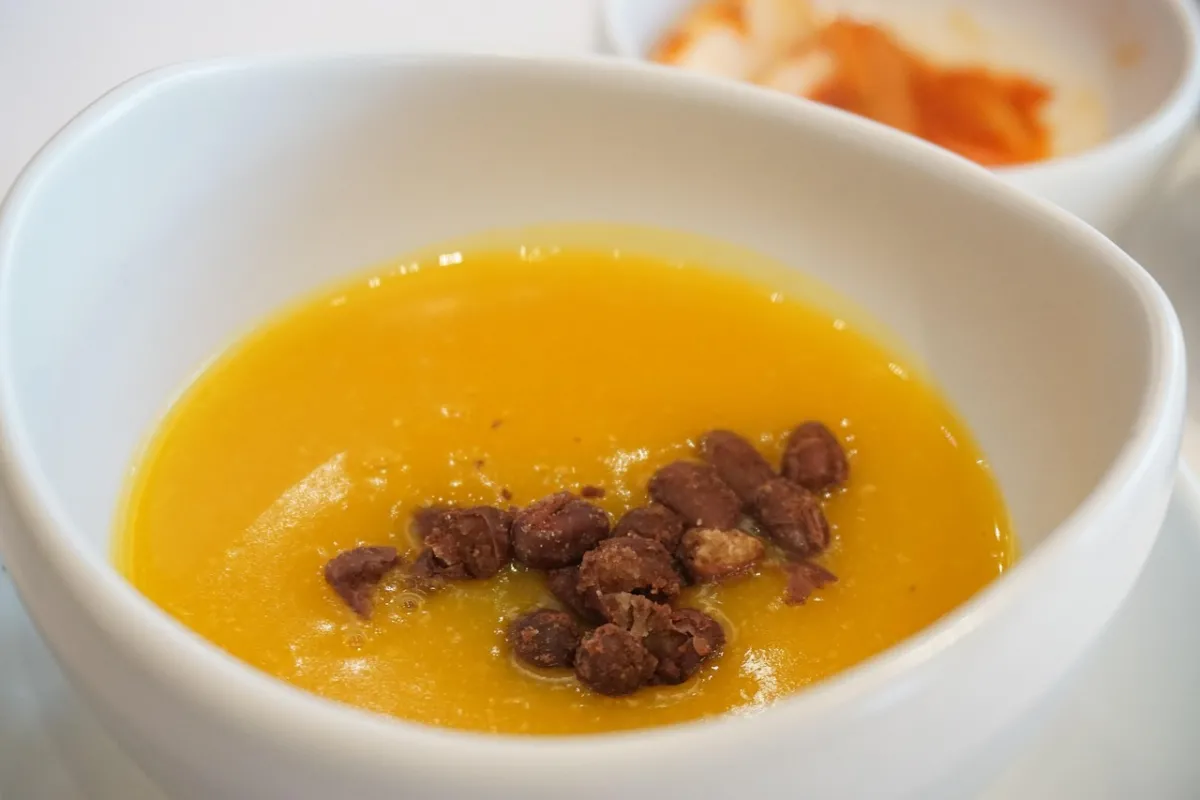
Bright golden and naturally sweet, hobakjuk is made from Korean pumpkin or kabocha squash cooked until soft, puréed and thickened with glutinous rice flour. It is often finished with sweet red beans, small chewy rice balls or a few pine nuts. Hobakjuk is a favourite starter at Korean buffets and wedding banquets, and many people treat it as an easy, filling breakfast.
Jeonbokjuk (전복죽) – Abalone Porridge
Jeonbokjuk is often called the king of juk. Sliced abalone is sautéed in sesame oil with soaked rice and then simmered slowly. In some versions, especially on Jeju Island, the abalone innards are added to the pot, giving the porridge a pale green colour and a deeper sea flavour. It is rich, savoury and relatively expensive, so it is often chosen as a special gift meal for someone who needs looking after.
Patjuk (팥죽) – Red Bean Porridge
Patjuk is made from red beans (adzuki beans) boiled, mashed and strained into a deep reddish-brown porridge, usually with chewy glutinous rice balls called saealsim (새알심, "bird egg centres") inside. Some regions season it with salt and eat it savoury, while others add sugar. Patjuk is closely tied to the winter solstice, when families traditionally ate it to welcome the coldest part of the year.
Yachaejuk (야채죽) – Vegetable Porridge
Yachaejuk is the everyday, practical juk: finely chopped carrot, courgette, onion, mushroom and sometimes potato cooked with rice and seasoned lightly with salt or soy sauce. It is mild and colourful, and it is one of the easiest types to make at home with leftover vegetables.
Dakjuk (닭죽) – Chicken Porridge
Dakjuk is made by simmering chicken with garlic and sometimes ginseng or jujubes, then cooking rice in the broth and adding shredded meat. It is especially popular in summer around the hottest days, when Koreans traditionally eat warming chicken dishes, and many families make dakjuk with the leftover broth after a pot of chicken soup.
Jatjuk and Heugimjajuk (잣죽·흑임자죽) – Pine Nut and Black Sesame Porridge
These two elegant, nutty porridges are made by grinding soaked rice together with pine nuts or toasted black sesame seeds. Jatjuk is creamy white and delicate; heugimjajuk is grey-black, toasty and fragrant. Both were associated with the royal court and are still served at traditional restaurants and as gentle starters at formal meals.
Juk at a Glance
| Type | Main ingredients | Flavour | Often eaten |
|---|---|---|---|
| Huinjuk (white juk) | Rice, water | Very mild; seasoned at the table | As a plain, light meal |
| Hobakjuk | Pumpkin, glutinous rice flour, red beans | Naturally sweet | Breakfast, banquet starter |
| Jeonbokjuk | Abalone, rice, sesame oil | Rich and savoury | Special treat or caring gift |
| Patjuk | Red beans, rice balls | Earthy; savoury or sweet | Winter solstice, cold days |
| Yachaejuk | Mixed vegetables, rice | Light and mild | Everyday home meal |
| Dakjuk | Chicken, garlic, rice | Savoury and warming | Summer and cold-weather comfort |
| Jatjuk / Heugimjajuk | Pine nuts or black sesame, rice | Nutty and smooth | Traditional restaurants, formal starters |
Juk as Comfort Food
If you tell a Korean friend that you have a cold or a stomach that is not quite right, there is a good chance they will suggest juk. In Korean culture juk is the classic "looking after someone" food, in the same way that chicken soup is in many Western homes. Parents make it for children who stayed home from school, partners buy it on the way home, and friends have it delivered to someone recovering after a long week.
The reasons are mostly practical and cultural. Juk is soft, warm, mild and easy to eat in small amounts, and it can be made as plain or as rich as the person wants. Carrying a container of juk to someone is also a gesture: it shows that you thought about what they might be able to eat.
It is worth keeping this cultural role in perspective. Juk is a gentle meal, not a treatment. If you are unwell, have a medical condition, follow a special diet after surgery, or have concerns about allergies (for example to shellfish, nuts or sesame), follow the advice of your doctor or another qualified health professional about what and when to eat.
How Juk Restaurants Work
In Korean cities you will see restaurants that specialise only in juk, including several well-known franchise chains. They are usually bright, clean and quiet, popular with office workers at lunch, older customers and people picking up takeaway.
- The menu. Expect a long list: plain, pumpkin, red bean, vegetable, beef and mushroom, seafood, abalone, chicken, kimchi and seasonal specials. Prices vary by ingredient, with abalone and octopus among the most expensive.
- Portions. A standard bowl is a full meal. Some shops offer smaller sizes or a "special" version with extra toppings.
- Side dishes. Juk normally comes with a small set of side dishes, such as soy-braised beef, kimchi and lightly seasoned pickles.
- Takeaway. A large share of juk is sold to go, packed in sealed containers with the side dishes in separate small tubs. Many shops also deliver through food delivery apps.
- Seasoning. Juk is often cooked mildly so that you can adjust it yourself with soy sauce, salt or a little of the side dishes.
Outside specialty shops, juk also appears at hotel breakfast buffets, as the first course of traditional set menus and wedding banquets, and in ready-to-eat form in supermarkets. If you are travelling, the pouches and cups of juk sold at Korean convenience stores make a simple warm breakfast on a cold morning.
What to Eat with Juk: Side Dishes
Because juk is soft and mild, the side dishes served with it are chosen to add saltiness, crunch and contrast. Typical companions include:
- Jangjorim (장조림) – beef or quail eggs braised in soy sauce, shredded and spooned onto the porridge.
- Kimchi – usually a milder, younger kimchi or water kimchi (nabak-kimchi) that does not overwhelm the juk.
- Jangajji (장아찌) – vegetables pickled in soy sauce or soybean paste, cut into small pieces.
- Seasoned seaweed or myeolchi bokkeum – toasted laver or stir-fried anchovies for a little crunch.
- Soy sauce – a small dish of soy sauce, sometimes mixed with sesame and spring onion, for seasoning.
You can read more about these small plates in our guide to Korean banchan. As a rule, savoury juk pairs with salty side dishes, while sweet juk such as hobakjuk is usually eaten with just a little kimchi or on its own.
How to Eat Juk: Small Etiquette Tips
Juk is an informal food, but a few habits make it more enjoyable:
- Use a spoon. Juk is eaten with a spoon; chopsticks are only used for the side dishes.
- Eat from the edge. Freshly made juk is very hot. Koreans often take spoonfuls from the cooler edge of the bowl and work inwards.
- Season gradually. Add soy sauce or side dishes a little at a time rather than stirring everything in at once.
- Do not double-dip into shared bowls. If juk is served from a shared pot, use the serving ladle to fill your own bowl.
These habits follow the wider rules described in our guide to Korean table manners, such as waiting for elders to start and not lifting the rice bowl to your mouth.
Basic Principles for Making Juk at Home
Most juk recipes follow the same basic steps, so once you learn them you can create your own versions.
- Soak the rice. Soak short-grain rice for at least 30 minutes to an hour. Soaked rice breaks down faster and gives a creamier texture.
- Break the grains. For a smooth juk, crush the soaked rice lightly in a mortar, pulse it a few times in a blender, or rub it between your hands.
- Toast in sesame oil. Sauté the rice in a little sesame oil for a few minutes. This adds a nutty aroma and helps the grains release starch.
- Use plenty of water. A common ratio is about six to seven cups of water or stock for one cup of rice, added in stages.
- Stir from the bottom. Use a wooden spoon and stir regularly, especially as the porridge thickens, so it does not stick and scorch.
- Season at the end. Add salt or soy sauce only when the texture is right, because the porridge thickens and concentrates as it cooks.
Juk keeps thickening as it cools. When you reheat it, add a splash of water and stir over low heat until it loosens again.
Recipe 1: Golden Pumpkin Juk (Hobakjuk)
This version uses kabocha squash, which is easy to find outside Korea and has the dense, sweet flesh that makes good hobakjuk.
Ingredients (serves 3–4)
- 1 small kabocha squash (about 800 g to 1 kg)
- 4 cups (about 1 litre) water
- 5 tablespoons glutinous (sweet) rice flour
- ½ cup cooked sweet red beans, or canned red beans in light syrup (optional)
- ¼ teaspoon salt
- 1–3 tablespoons sugar or honey, to taste
- A few pine nuts for garnish (optional)
Method
- Cut the squash in half, scoop out the seeds and cut it into large pieces. Steam or microwave the pieces until soft enough to scrape the flesh easily from the skin.
- Scoop the flesh into a pot, add about 3 cups of the water and bring to a gentle boil. Mash it or blend it with a stick blender until smooth.
- Mix the glutinous rice flour with the remaining 1 cup of cold water until there are no lumps.
- Lower the heat and pour the flour mixture slowly into the pumpkin while stirring constantly. Simmer for 5–8 minutes until the porridge thickens and turns glossy.
- Add the salt and sweeten to taste. Stir in the red beans if using and warm through.
- Serve hot, topped with a few pine nuts or extra red beans.
For a more traditional touch, make small rice balls by kneading glutinous rice flour with a little hot water, rolling them into marble-sized balls and simmering them in the porridge until they float.
Recipe 2: Everyday Vegetable Juk (Yachaejuk)
This savoury juk is a good way to use up small amounts of vegetables and is mild enough for a light lunch.
Ingredients (serves 2–3)
- 1 cup short-grain rice, soaked for 1 hour and drained
- 1 tablespoon sesame oil
- About 1 cup finely diced mixed vegetables (carrot, courgette, onion, mushroom)
- 6–7 cups water or light vegetable or anchovy stock
- 1 teaspoon soup soy sauce or salt, to taste
- Toasted sesame seeds, crumbled roasted seaweed and chopped spring onion to finish
Method
- Lightly crush the soaked rice so that most grains are broken into two or three pieces.
- Heat the sesame oil in a heavy pot over medium heat. Add the rice and stir for 2–3 minutes until it turns slightly translucent.
- Add the harder vegetables, such as carrot and onion, and stir for another minute.
- Pour in about 5 cups of water or stock, bring to a boil, then reduce to low heat. Simmer for 20–25 minutes, stirring often, and add more liquid if it becomes too thick.
- Add the softer vegetables, such as courgette and mushroom, and cook for another 5 minutes until the grains are completely soft.
- Season with soup soy sauce or salt, then serve topped with sesame seeds, seaweed and spring onion.
To turn this into a heartier meal, stir in a beaten egg in the last minute or add shredded cooked chicken. For broth ideas, see our guide to Korean soups and stews.
Common Mistakes and How to Fix Them
| Problem | Likely cause | Fix |
|---|---|---|
| Juk is gluey and stuck to the pot | Heat too high, not stirred enough | Use a heavy pot on low heat and stir from the bottom |
| Grains stay whole and separate | Rice not soaked or not crushed | Soak longer and crush the rice before cooking |
| Too thick after reheating | Juk naturally thickens as it cools | Add a little hot water and stir over low heat |
| Pumpkin juk is lumpy | Flour added too quickly or into boiling liquid | Dissolve flour in cold water first and pour it in slowly while stirring |
| Tastes flat | Under-seasoned or plain water used | Use stock, toast the rice in sesame oil and season at the end |
Regional and Modern Variations
Juk changes with the region and the season. Coastal areas make porridges with clams, octopus or sea urchin, while Jeju Island is famous for abalone juk and seaweed juk. Mountain areas use wild greens, mushrooms and acorn starch. In autumn, chestnut and pine nut juk appear; in winter, patjuk and pumpkin juk dominate.
Modern juk shops have added their own ideas: kimchi and tuna juk, bulgogi juk, cheese-topped juk and spicy octopus juk. Some cafés serve small cups of sweet juk, such as hobakjuk and black sesame porridge, alongside traditional teas, much like the dishes described in our guide to Korean desserts and traditional teas.
At home, juk is also a smart way to avoid waste. Leftover rice can be simmered with water and vegetables into a quick juk in about fifteen minutes, which many Korean families call "rice porridge from leftover rice". It will not be as smooth as juk made from raw rice, but it is warm, fast and comforting.
Frequently Asked Questions
Is juk the same as congee?
They are close relatives. Both are rice porridges, but Korean juk is often thicker and creamier because the rice is ground or crushed, and Korea has many naturally sweet versions, such as pumpkin and red bean juk, which are eaten as meals.
Is juk eaten only when people are ill?
No. Juk is a common comfort food for recovery days, but Koreans also eat it for breakfast, as a light lunch, as a banquet starter and simply because they enjoy it. Specialty restaurants are busy with healthy customers every day.
What is the most popular type of juk?
Pumpkin juk (hobakjuk) and abalone juk (jeonbokjuk) are among the best known. Vegetable juk and beef and mushroom juk are very common everyday choices at juk restaurants.
Can I make juk with leftover cooked rice?
Yes. Simmer cooked rice with about two to three times its volume of water or stock, stirring often, until it breaks down. It cooks quickly, although the texture is slightly less silky than juk made from soaked raw rice.
Is hobakjuk a dessert?
Not usually. Although it is naturally sweet, hobakjuk is typically eaten as a light meal or a starter. You can reduce or skip the added sugar if you prefer a more savoury taste.
How long does homemade juk keep?
Cool it quickly, store it in a covered container in the refrigerator and eat it within a day or two. Reheat it gently with a little water until it is hot all the way through.
Final Thoughts
Juk shows a quieter side of Korean cooking: patient, gentle and full of care. A golden bowl of pumpkin porridge, a savoury spoonful of abalone juk or a simple vegetable porridge made from what is left in the fridge can all say the same thing — "eat something warm and rest a little". Whether you try it at a juk restaurant in Seoul, pick up a pouch from a convenience store or make a pot in your own kitchen, juk is one of the easiest and most comforting ways to bring Korean food culture into everyday life.