Seoul Traditional Markets Guide: Gwangjang, Namdaemun, Tongin, Mangwon and Gyeongdong Markets, What to Eat and How to Visit
If you want to see everyday life in Seoul, head to a traditional market. This guide covers Gwangjang Market's mung bean pancakes and yukhoe, the endless stalls of Namdaemun, Tongin Market's coin lunch box, the neighbourhood feel of Mangwon and the herbal aromas of Gyeongdong, plus payment, etiquette and timing tips.

Contents
- Why visit a traditional market in Seoul?
- Gwangjang Market: Seoul's most famous food market
- Namdaemun Market: everything under the sun
- Tongin Market: the coin lunch box experience
- Mangwon Market: a true neighbourhood market
- Gyeongdong Market: herbs, harvests and a new generation
- A quick comparison
- Practical tips for visiting Seoul's markets
- Suggested market-themed day in Seoul
- Other markets worth knowing
- What to buy at Seoul's markets
- The changing seasons of the market
- Useful Korean phrases for the market
- Frequently asked questions
- Final thoughts: meeting the real Seoul in its markets
Seoul is famous for its glittering shopping malls, trendy cafés and futuristic skyline. But if you want to see how people in the city really live, eat and shop, there is no better place than a traditional market. Walk down a narrow alley and you will find sizzling griddles of pancakes sending up clouds of steam, mountains of fresh vegetables and fruit, rows of dried fish and seaweed, and vendors calling out to passers-by. The noise, the smells and the energy create an atmosphere that no department store can match.
Traditional markets, known in Korean as jeontong sijang (전통시장), have been at the heart of neighbourhood life for generations. Long before supermarkets appeared, this is where families bought their groceries, clothes and household goods, and where workers grabbed a quick, filling meal. Many markets have adapted over the years, adding covered roofs, modern signage and card payment, yet they still keep much of their original character and warmth.
For travellers, markets offer something special: delicious, affordable food, a chance to interact with locals, and a glimpse of a side of Seoul that feels very different from the polished image seen in films and dramas. In this guide we introduce five of the best traditional markets for visitors, explain what makes each one special and what to eat there, and share practical tips on payment, etiquette, timing and getting around.
Why visit a traditional market in Seoul?
There are many reasons to add at least one market to your Seoul itinerary. First, the food is excellent value. You can often enjoy a satisfying meal of street food or a simple restaurant dish for far less than you would pay in a tourist district. Second, markets are one of the best places to try classic Korean dishes cooked in front of you, from freshly fried pancakes to hand-cut noodles.
Third, markets are full of life. They are where you can watch vendors skilfully making dumplings, hear the lively exchanges between shopkeepers and regular customers, and see the seasonal rhythm of Korean food, as spring greens give way to summer fruit and autumn harvests. Finally, markets are a good place to find practical souvenirs such as dried seaweed, ginseng products, kitchen utensils and traditional snacks, often at better prices than in souvenir shops.
Gwangjang Market: Seoul's most famous food market
Located in the Jongno district, Gwangjang Market (광장시장) is one of the oldest and best-known markets in Korea, with a history stretching back more than a century. While the market sells fabrics, bedding and clothing, most visitors come for its legendary food alley, where dozens of stalls are packed tightly together under a covered roof.
The star dish is bindaetteok (빈대떡), a thick, crispy pancake made from freshly ground mung beans mixed with vegetables and sometimes pork. You can watch vendors grinding the beans with stone mills and frying the pancakes in generous amounts of oil until golden. Another favourite is mayak gimbap (마약김밥), small finger-sized rolls of rice and vegetables wrapped in seaweed and served with a tangy mustard dipping sauce. The name, which jokingly suggests the rolls are "addictive", reflects how hard it is to stop eating them.
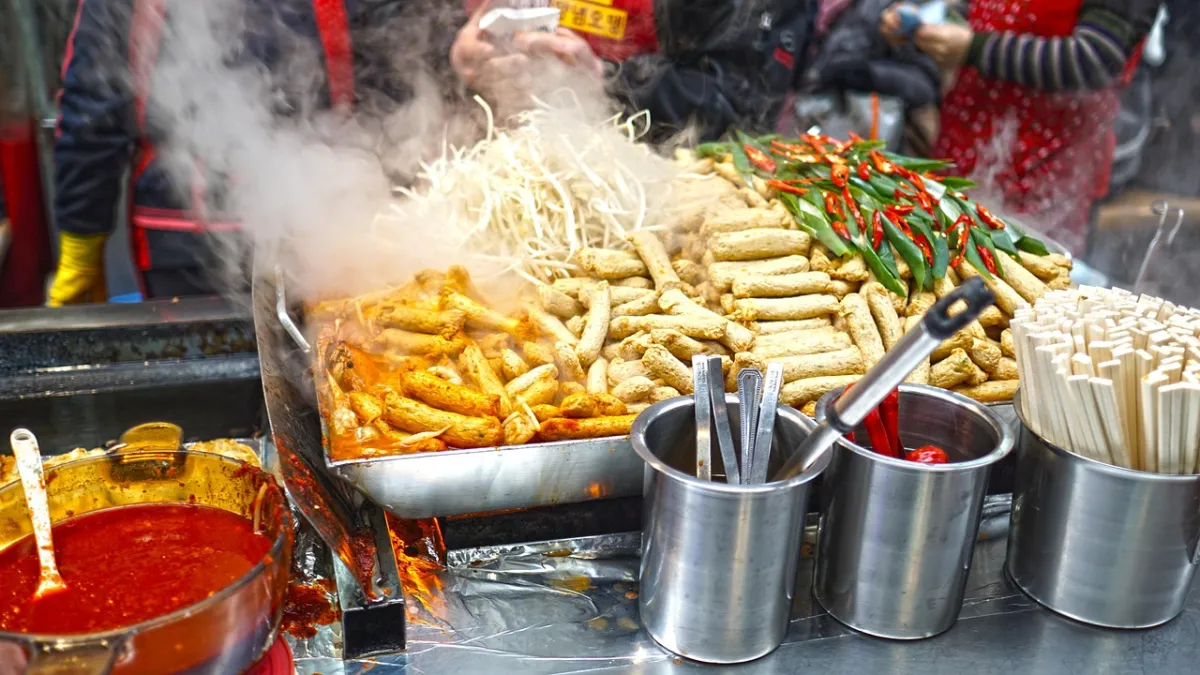
Gwangjang Market is also famous for yukhoe (육회), a dish of seasoned raw beef often topped with egg yolk and served with slices of Korean pear. Several restaurants in and around the market specialise in it. Other popular choices include tteokbokki, sundae (Korean blood sausage), kalguksu (hand-cut noodle soup) and mandu (dumplings).
The typical way to eat here is to sit on a long bench in front of a stall, point to what you want and eat right there while the vendor cooks. It is casual, quick and very sociable. The upper floor of the market is home to traditional hanbok fabric and bedding shops, which make for an interesting stroll after your meal.
Getting there: Jongno 5-ga Station (Line 1) or Euljiro 4-ga Station (Lines 2 and 5) are both a short walk away. The food alley tends to be busiest in the early evening and at weekends.
Namdaemun Market: everything under the sun
Next to Sungnyemun Gate, one of Seoul's historic city gates, lies Namdaemun Market (남대문시장), one of the largest traditional markets in Korea. Its maze of streets and buildings is home to thousands of shops selling an astonishing range of goods: clothing, children's wear, glasses, accessories, kitchenware, camping gear, flowers, ginseng, dried seaweed and much more. It is said that if you cannot find something at Namdaemun, you will not find it anywhere.
The market has several famous food alleys. The hairtail stew alley (갈치조림 골목) serves galchi jorim, pieces of hairtail fish braised in a spicy, savoury sauce with radish, usually served with rice and a selection of side dishes. The kalguksu alley offers bowls of hand-cut noodle soup, often with a small side of cold noodles or barley rice. Street stalls sell yachae hotteok, a savoury twist on the classic sweet pancake, filled with glass noodles and vegetables and fried until crisp, which frequently attracts long queues.
Namdaemun is also a good place to buy practical souvenirs, such as packs of seasoned seaweed, ginseng teas and traditional-style household items. Prices are generally reasonable, and some shops offer discounts when you buy several items.
Getting there: Hoehyeon Station (Line 4), Exit 5, opens directly onto the market. Many shops close on Sundays, so weekdays and Saturdays are the best times to visit. Some wholesale sections open very early in the morning or even late at night.
Tongin Market: the coin lunch box experience
Tucked away in Seochon, the charming neighbourhood just west of Gyeongbokgung Palace, Tongin Market (통인시장) is a compact local market with a friendly, small-town feel. It is best known for its creative coin lunch box (엽전 도시락) programme.
Here is how it works. At the market's customer centre or lunch box café, you exchange cash for a set of old-style brass coins, called yeopjeon, and receive an empty plastic lunch tray. You then walk through the market, stopping at participating stalls marked with a sign, and exchange a coin or two for a portion of each dish you want: perhaps some japchae, a piece of fried chicken, rolled omelette, seasoned vegetables or a few dumplings. When your tray is full, you return to the café to eat, where you can buy rice and soup to complete your meal. It is a fun, interactive way to try many dishes in small portions.
Another Tongin speciality is gireum tteokbokki (기름떡볶이), rice cakes stir-fried in oil with either a soy-based or a red pepper seasoning, which gives them a slightly crisp texture quite different from the familiar saucy version.
The lunch box café keeps set operating hours and closes on certain days, so it is a good idea to check the latest schedule before your visit. Tongin Market combines perfectly with a visit to Gyeongbokgung Palace and a walk through the art galleries, cafés and hanok alleys of Seochon. The nearest station is Gyeongbokgung Station (Line 3).
Mangwon Market: a true neighbourhood market
In the Mapo district, not far from the trendy streets of Hongdae and Hapjeong, Mangwon Market (망원시장) is first and foremost a place where local residents do their daily shopping. Vegetables, fish, meat, rice cakes and side dishes are sold at prices that attract shoppers from across the area.
In recent years, Mangwon has also become popular with young Koreans and visitors thanks to its affordable and delicious snacks. Look out for croquettes filled with vegetables, curry or sweet red bean; dakgangjeong (닭강정), crispy fried chicken pieces coated in a sweet and spicy glaze; handmade pork cutlets; and steaming bowls of kalguksu. Many stalls sell small portions, which makes it easy to try several things.
A popular way to enjoy Mangwon is to pick up snacks at the market and then walk about fifteen minutes to Mangwon Hangang Park on the banks of the Han River, where you can have a picnic and watch the sunset over the water. The nearest station is Mangwon Station (Line 6).
Gyeongdong Market: herbs, harvests and a new generation
In the Jegi-dong area of Dongdaemun-gu, Gyeongdong Market (경동시장) is one of the largest markets in Korea for agricultural products and traditional herbal ingredients. It sits next to the historic Seoul Yangnyeongsi, Seoul's traditional herbal medicine market, and the air around it is filled with the earthy scent of roots, barks and dried herbs.
Here you will find enormous displays of ginseng, jujubes, dried mushrooms, sesame, grains, chillies and seasonal produce, often at very reasonable prices. It is a fascinating place to see the variety of ingredients used in Korean cooking. In recent years, the market has also attracted younger visitors with a youth mall of small restaurants and a café created in a renovated old theatre building inside the market, which has become a popular photo spot.
Herbal products are a big part of the market's identity. If you are interested in buying them, it is wise not to rely on exaggerated claims about their effects, and to consult a doctor or qualified professional first, especially if you have a health condition, are pregnant or take any medication. The nearest station is Jegi-dong Station (Line 1).
A quick comparison
| Market | Best for | Must-try | Nearest station |
|---|---|---|---|
| Gwangjang | Street food | Bindaetteok, mayak gimbap, yukhoe | Jongno 5-ga |
| Namdaemun | Shopping and souvenirs | Hairtail stew, vegetable hotteok | Hoehyeon |
| Tongin | Coin lunch box, palace area | Coin lunch box, oil tteokbokki | Gyeongbokgung |
| Mangwon | Local atmosphere, snacks | Croquettes, dakgangjeong | Mangwon |
| Gyeongdong | Produce and herbs | Seasonal produce, youth mall food | Jegi-dong |
Practical tips for visiting Seoul's markets
Payment
Most shops and many food stalls now accept credit and debit cards, and some accept mobile payment. However, smaller stalls may prefer cash or bank transfers, so it is a good idea to carry some small notes and coins. Some markets also accept Onnuri gift certificates, a voucher used to support traditional markets, though as a visitor you will rarely need them.
Opening hours
Markets are generally most lively from around 10 a.m. to 7 p.m. Food alleys, especially in Gwangjang Market, often stay open later into the evening. Opening days vary by market and by shop, and many shops in some markets close on Sundays or on specific days of the month, so check before you go if there is a particular place you want to visit.
Bargaining
Food prices are fixed and usually displayed on boards or menus. Bargaining is not expected when buying food. When buying clothing or several items in a shop, it is acceptable to ask politely whether there is a discount, but aggressive haggling is not part of Korean market culture. A friendly smile and a simple question usually work best.
Etiquette
Market alleys can be narrow and crowded, so avoid stopping suddenly in the middle of a walkway, and keep large bags close to your body. Ask before taking close-up photos of vendors or their stalls, especially when they are busy working. If you sit down at a food stall, it is polite to order something rather than just resting. Many vendors appreciate a few words of Korean, such as annyeonghaseyo (hello), igeo juseyo (this one, please) and gamsahamnida (thank you).
Food safety and allergies
Popular stalls with a steady stream of customers tend to have a fast turnover of ingredients. Choosing busy stalls where you can see the food being cooked is a sensible approach. If you are unsure about raw dishes such as yukhoe or raw seafood, you can stick to cooked dishes. If you have food allergies, prepare a short note in Korean listing the ingredients you need to avoid, as many market dishes contain wheat, soy, sesame, seafood or nuts.
Suggested market-themed day in Seoul
If you want to dedicate a day to markets, here is one simple plan. Start the morning at Tongin Market with a coin lunch box brunch, then visit Gyeongbokgung Palace and stroll through Seochon. In the afternoon, head to Namdaemun Market for shopping and a snack of vegetable hotteok. In the evening, make your way to Gwangjang Market for bindaetteok, mayak gimbap and a lively dinner on the benches of the food alley. Alternatively, if you prefer a quieter, local experience, spend the late afternoon at Mangwon Market and finish with a picnic by the Han River.
Other markets worth knowing
The five markets above are excellent starting points, but Seoul has dozens of other markets, each with its own speciality. Here are a few more that are worth considering if you have extra time.
- Noryangjin Fisheries Wholesale Market: Seoul's largest seafood market is a fascinating place to see the enormous variety of fish, shellfish, crabs and other sea creatures eaten in Korea. A popular experience is to choose live seafood from a vendor on the main floor and then take it to one of the restaurants upstairs, where it is prepared as sashimi or a spicy fish stew for a table fee. Prices depend on weight and the market rate of the day, so ask clearly about the price before you buy, and agree on the total including preparation.
- Jungbu Market: Near Euljiro, this market specialises in dried seafood. It is lined with shops selling dried anchovies, squid, shrimp, pollack and seaweed. These products are compact and long-lasting, making them practical souvenirs or gifts for friends who love Korean cooking.
- Seasonal night markets: In the warmer months, night markets with food trucks, handmade crafts and live music are sometimes held in places such as Han River parks. Their dates, locations and themes change from year to year, so check the official tourism information for the current schedule before planning a visit.
What to buy at Seoul's markets
Markets are a great place to pick up souvenirs that are both practical and authentically Korean. Some popular choices include:
- Seasoned seaweed (gim): Light, inexpensive and loved by almost everyone, packs of roasted seasoned seaweed are among the most popular Korean souvenirs.
- Citron tea (yuja-cha): A jar of sweet citron marmalade that can be mixed with hot water to make a fragrant tea, especially popular in winter.
- Sesame oil and perilla oil: Many market shops press their own oils, which have a rich, nutty aroma. Make sure bottles are well sealed and packed securely for travel.
- Brass spoons and chopsticks: Traditional brassware and stainless steel utensils make elegant, durable gifts.
- Fabric goods: Small pouches, bags and coasters made from colourful hanbok fabric, often available near the fabric shops of Gwangjang Market.
- Traditional snacks: Rice puffs, yakgwa (honey cookies) and other sweets that are fun to share.
Before buying any food item to take home, remember to check the customs rules of your home country, as regulations on meat, fresh produce, seeds and some plant products can be strict.
The changing seasons of the market
One of the joys of visiting a traditional market is seeing how its displays change with the seasons. In spring, stalls are filled with fresh wild greens such as shepherd's purse and wild chives, which Koreans use in soups and seasoned side dishes. In summer, piles of bright yellow Korean melons and huge watermelons take centre stage. Autumn brings new-crop rice, chestnuts, sweet potatoes, persimmons and apples. In winter, markets fill with napa cabbages, radishes, chilli powder and salted seafood for gimjang, the traditional season of making kimchi in large batches.
The gimjang season, usually from late November to early December, is a particularly lively time to visit. Trucks loaded with cabbages line the streets, and families and neighbours buy ingredients in large quantities to prepare enough kimchi for the whole winter. Even if you are not making kimchi yourself, watching this tradition in action is a memorable glimpse of Korean food culture.
Useful Korean phrases for the market
You do not need to speak fluent Korean to enjoy a market, but a few short phrases make every interaction smoother and often earn a warm smile from vendors.
- Igeo eolmayeyo? (이거 얼마예요?) – How much is this?
- Hana juseyo. (하나 주세요) – One, please.
- Pojang hae juseyo. (포장해 주세요) – Please pack it to take away.
- Kadeu dwaeyo? (카드 돼요?) – Can I pay by card?
- Deol maepge hae juseyo. (덜 맵게 해 주세요) – Please make it less spicy.
- Masisseoyo! (맛있어요!) – It's delicious!
Telling a vendor that their food is delicious is one of the nicest ways to end a meal, and it is often met with a big smile or even a small extra treat.
Frequently asked questions
Which market should a first-time visitor choose?
If food is your priority, Gwangjang Market is the easiest and most rewarding choice. If you want shopping and souvenirs, Namdaemun Market offers the widest range. For a relaxed, local atmosphere, Mangwon Market is a great option.
Can I visit markets in the evening?
Yes. Many food stalls, particularly in Gwangjang Market, stay open into the evening. However, general shops often close earlier, so if you want to shop, it is better to go during the day.
Are traditional markets suitable for children?
Generally yes, and children often enjoy the colours and snacks. Because alleys can be crowded and some stalls use hot oil and griddles, keep a close eye on young children.
Do vendors speak English?
Some vendors in popular tourist markets know basic English, and many menus include pictures or English translations. Pointing, a few Korean words and a translation app are usually enough to order successfully.
Can I bring market food back home?
Packaged items such as dried seaweed and some snacks travel well, but many countries restrict the import of meat, fresh produce and certain plant products. Check the customs rules of your destination before buying food to take home.
Final thoughts: meeting the real Seoul in its markets
Traditional markets are where Seoul's warmth, history and everyday energy come together most vividly. A plate of crispy bindaetteok, a lunch tray filled coin by coin, or a bag of croquettes eaten by the river can easily become the moments you remember most from your trip. On your next visit to Seoul, make sure to set aside a few hours for at least one market. Come hungry, take your time, and enjoy the sights, sounds and flavours of the city at its most authentic.